
Table of Contents
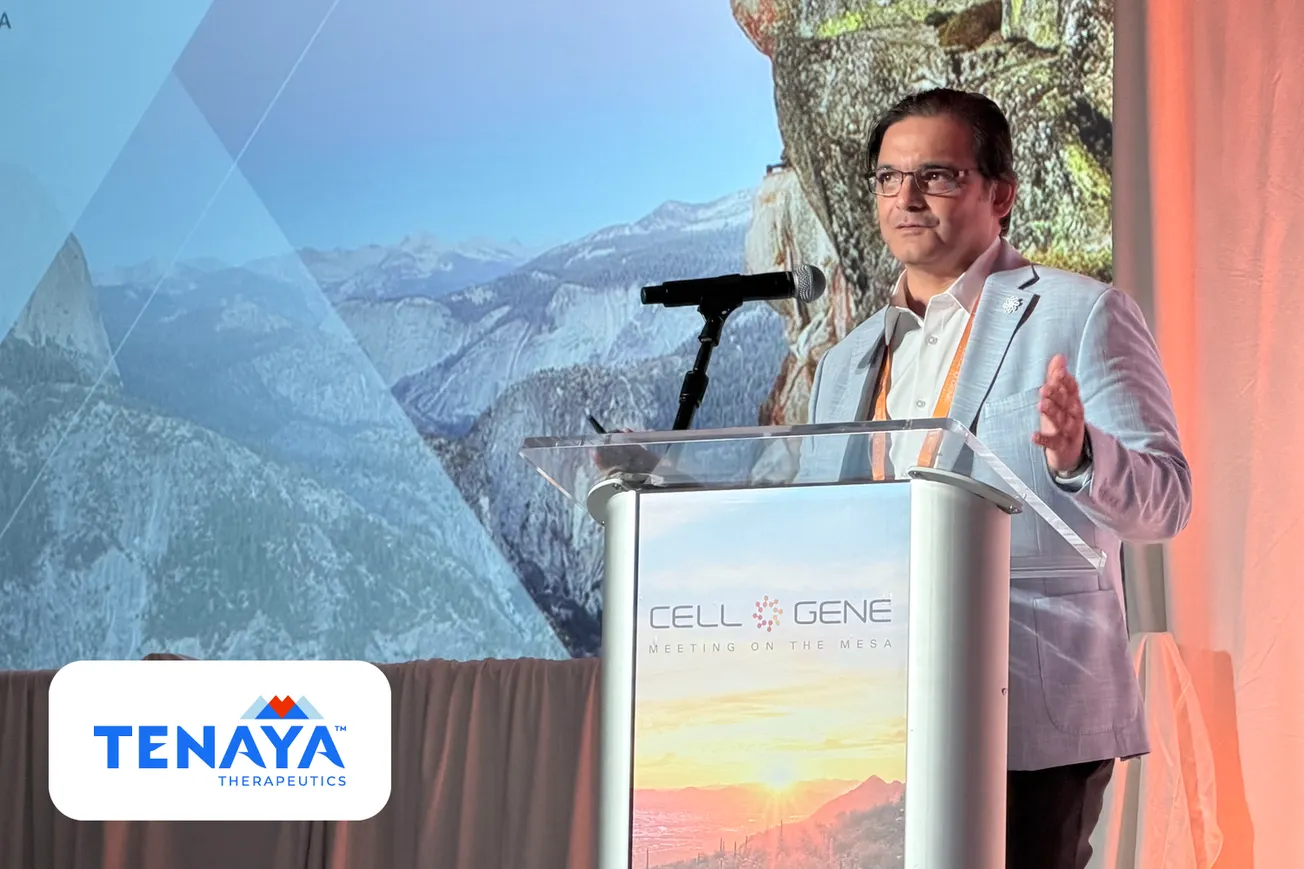
Tenaya Therapeutics expects to provide an update by the end of 2026 on its regulatory discussions over pivotal trials for its two heart disease gene therapies, CEO Faraz Ali said in an Innovation Spotlight presentation at the Cell & Gene Meeting on the Mesa in Phoenix on Tuesday, October 6, 2026.
“The big question is what will be approvable endpoints in the design of a pivotal study,” Ali said of TN-201, for MYBPC3-associated hypertrophic cardiomyopathy (HCM), and TN-401, for PKP2-associated arrhythmogenic right ventricular cardiomyopathy (ARVC). Tenaya said in August that it had completed the enrollment needed in both studies to inform dose selection for late-stage trials. All of the clinical data Ali presented were interim and company-reported.
Ali opened by describing Tenaya as “100% focused on heart disease”, working on both rare genetic and more prevalent forms. “We do that because we are modality agnostic,” Ali said. “We are doing gene therapy, gene editing, small molecule, you name it.”
Ali put the US patient population at about 120,000 for MYBPC3-associated HCM and about 70,000 for PKP2-associated ARVC.
In the MyPEAK-1 trial of TN-201, which has tested doses of 3E13 and 6E13 vg/kg, Ali said “these are very severe patients at baseline”, and that four of the six patients had previously undergone open-heart surgery to remove excess heart tissue. All six patients with data had a reduction in hypertrophy, four of them by more than 10%, and the effect in the first cohort had lasted one to two years, according to Ali.
Ali said all six patients had started at New York Heart Association Class II or III, and that five of the six were now at Class I. In three patients at the high dose, “you’re seeing an average improvement of 36 points” on the patient-reported Kansas City Cardiomyopathy Questionnaire, Ali said. “TN-201 has been well tolerated at both doses. There have been no cardiotoxicities or dose-limiting toxicity,” Ali said.
Ali singled out children with the disease: “Children, they’re rare but extraordinarily severe.” Among homozygous infants, “85% of them die or require a transplant before the age of one,” Ali said, adding: “There is no therapy on earth that can do anything for them other than a heart transplant.”
For ARVC, Ali said, “the hallmark of the disease is profound arrhythmia”, and “unfortunately for too many patients, the first manifestation of this disease is that they collapse in the middle of some activity.” In the TN-401 study, Ali said, premature ventricular contractions (PVCs) fell by about 60% in the first dose cohort and about 67% in the second, with the reduction lasting to one year in the first two patients.
Ali said that global experts had recently backed PVC counts as an endpoint for pivotal studies in the disease, and that Tenaya would discuss this with regulators.
Ali also gave a brief update on TN-301, a small molecule HDAC6 inhibitor that has completed a Phase 1 study in healthy volunteers. Ali said Tenaya hopes to start one or more Phase 2 studies in the second half of 2027.
About Tenaya Therapeutics
Tenaya Therapeutics is a Nasdaq-listed (TNYA) clinical-stage biotechnology company based in South San Francisco, incorporated in 2016. In its second-quarter results on August 5, 2026, the company said it planned additional interim data from both gene therapy trials and updates on pivotal trial discussions in the fourth quarter of 2026, and reported cash of $78.1 million, which it expects to fund operations through the third quarter of 2027.
The FDA has granted TN-201 Fast Track, Orphan Drug and Rare Pediatric Drug designations, and the European Medicines Agency has granted it PRIME designation. TN-201 has also been accepted into the FDA’s Rare Disease Evidence Principles process for severe pediatric patients. TN-401 holds FDA Fast Track and Orphan Drug and EMA PRIME designations, and on September 14, 2026, Tenaya said the FDA had granted it RMAT designation. In March 2026 Tenaya entered a research collaboration with Alnylam Pharmaceuticals to discover and validate gene targets for cardiovascular disease, and received a $10 million upfront payment in April.
Onyx previously spoke with Ali in an Onyx Live interview at Cell & Gene Meeting on the Med 2026.
Sources: Tenaya Therapeutics Innovation Spotlight presentation, Cell & Gene Meeting on the Mesa, October 6, 2026; Cell & Gene Meeting on the Mesa agenda and presenter listing; Tenaya Therapeutics second-quarter 2026 results, August 5, 2026, and Form 10-Q for the quarter ended June 30, 2026; Tenaya Therapeutics Form 8-K, March 5, 2026; Tenaya Therapeutics press release, September 14, 2026; ClinicalTrials.gov NCT05836259 (MyPEAK-1) and NCT06228924 (RIDGE-1)
Coming up: Cell & Gene Leaders Live, Sun 15 Nov at The Shard · London Life Sciences Week Guide, 15–20 Nov 2026


Comments