
Table of Contents
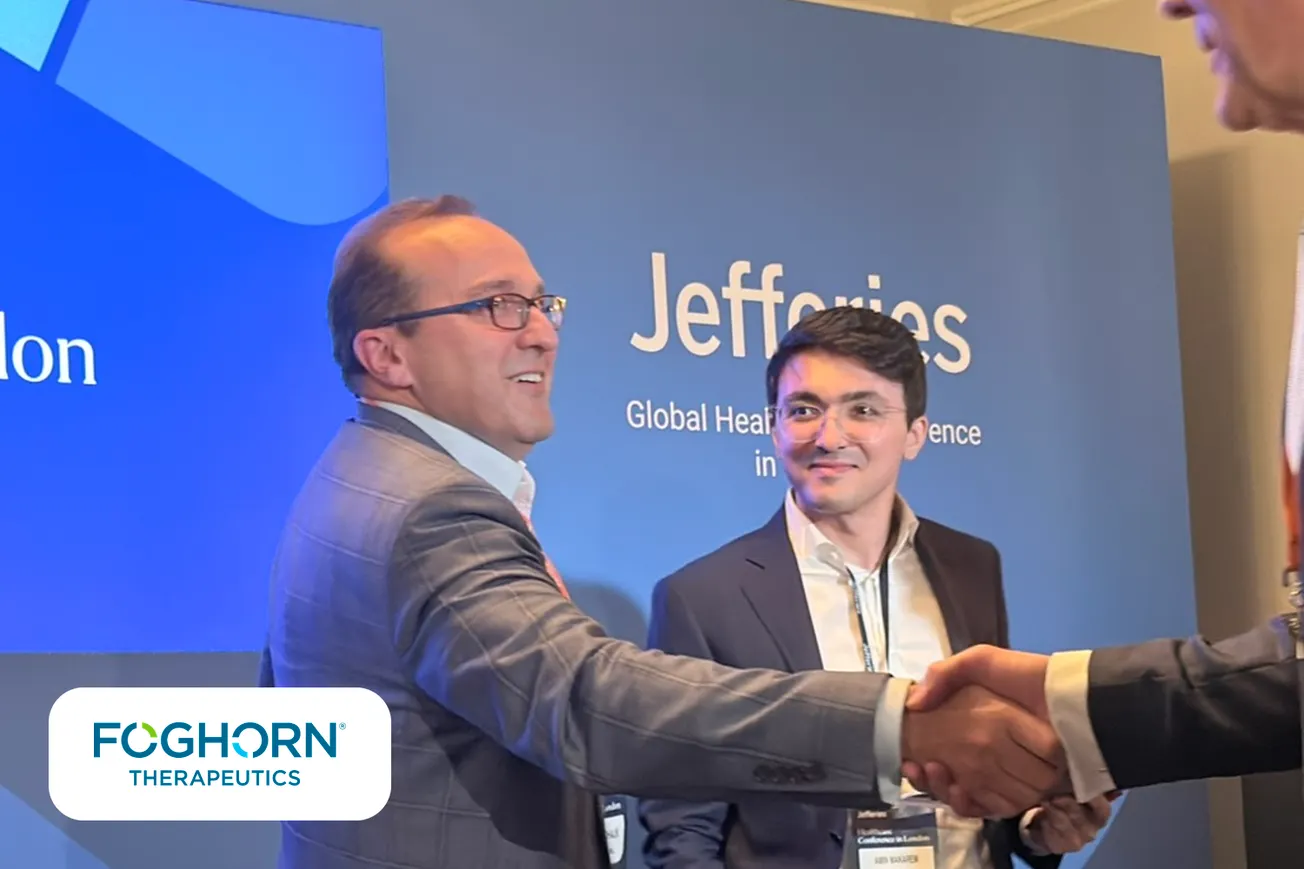
Foghorn Therapeutics used a fireside chat at the Jefferies Global Healthcare Conference in London on Monday, November 16, 2026 to argue that selectivity against hard-to-drug proteins carries its rebuilt pipeline, about seven weeks after it and Lilly said they would not advance their lead clinical program. President and chief executive officer Adrian Gottschalk said the company is now mostly preclinical, with an undisclosed oral drug for inflammatory bowel disease (IBD) and a selective EP300 degrader for blood cancers leading the way.
After FHD-909
On October 1, Foghorn said that it and Lilly would not take FHD-909, a SMARCA2 inhibitor studied in non-small cell lung cancer and other solid tumors, beyond Phase 1 dose escalation, and would not advance their SMARCA2 degrader. Foghorn announced a workforce cut of about 40% and refocused on its wholly owned programs.
An undisclosed target in IBD
The IBD drug is an oral small molecule, which Gottschalk expects to be dosed once daily, against a target Foghorn has not named, a choice Gottschalk put down to the “paranoia of yours truly about competition from other places in the world”. Gottschalk said that, as far as the company knows, no one has gone after the target in immunology and inflammation, and that drugging it requires a level of selectivity others have not reached.
Foghorn has reported that compounds from the program suppressed disease activity in a T-cell transfer colitis model and an IL-10 knockout model, with efficacy comparable to an anti-IL-12/23p40 antibody used as a positive control. Gottschalk said “preclinical models are valuable to a point, but these seem to be the most predictive”.
“My bias is to wait as long as possible on target disclosure,” Gottschalk said.
Foghorn expects dose-range finding studies to begin in the fourth quarter of 2026, with potential first-in-human studies by the end of 2027. Gottschalk said the first study is planned in healthy volunteers, likely in Australia, possibly with a cohort of IBD patients added.
Gottschalk said the drug, as an oral, could move earlier in treatment, and that current therapies leave room for better efficacy. “So you’re far from curing the majority of patients here,” Gottschalk said.
“We’re resourced financially to move this into the clinic ourselves,” Gottschalk said, while remaining open to partnering because “there’s always an economic rationale at some level with the right terms.”
The EP300 degrader
Gottschalk said what was exciting about the EP300 program is that the target already has clinical validation, pointing to CellCentric’s inobrodib, a dual CBP/EP300 inhibitor in multiple myeloma. Gottschalk said hitting both CBP and EP300 has been linked to effects on platelets, and that, in Gottschalk’s view, inobrodib’s schedule of four days on and three days off reflects those effects. “In our humble opinion, we think that leaves some efficacy on the table,” Gottschalk said. CellCentric has said inobrodib 20 mg plus pomalidomide-dexamethasone has tolerability consistent with pomalidomide-dexamethasone alone.
Foghorn has reported preclinical data in which its degrader showed greater anti-tumor activity than inobrodib in mouse models of multiple myeloma, including complete responses, and caused tumor regression in a model of pomalidomide resistance. The company also reported better body weight and platelet counts with its selective degrader than with dual CBP/EP300 targeting.
Gottschalk said the potential pre-development candidate degrades about 97% to 98% of EP300, with candidates 100- to 1,000-fold selective over CBP, and credited the better preclinical tolerability to that selectivity. “It’s the selectivity that’s eliminating the toxicity,” Gottschalk said.
Gottschalk said the goal is a once-weekly formulation and the company is still settling on the right molecule and formulation. Foghorn is targeting an IND in 2027, focused on multiple myeloma and diffuse large B-cell lymphoma. All Foghorn data cited here are preclinical and company-reported.
Cash
Foghorn reported $156.2 million in cash, cash equivalents and marketable securities at September 30, which it expects to fund operations into the second half of 2029.
About Foghorn Therapeutics
Foghorn Therapeutics (Nasdaq: FHTX) is a biotechnology company developing medicines against challenging biological targets through oral small molecules, targeted protein degradation and induced proximity, with programs in oncology and in immunology and inflammation, based in Watertown, Massachusetts.
Onyx has previously interviewed Adrian Gottschalk at JPM 2026 and reported on Foghorn’s chromatin biology.
Sources: Foghorn Therapeutics fireside chat, Jefferies Global Healthcare Conference, London, November 16, 2026; Foghorn investor conference announcement (November 3, 2026); Foghorn third quarter 2026 results (November 9, 2026); Foghorn FHD-909 and strategic priorities update (October 1, 2026); ClinicalTrials.gov NCT07096778 (inobrodib dosing); CellCentric DOMMINO-1 release (March 31, 2026); Foghorn AACR 2026 EP300 poster (April 2026)
Coming up: Cell & Gene Leaders Live, Sun 15 Nov at The Shard · London Life Sciences Week Guide, 15–19 Nov 2026 ·



Comments