
Table of Contents
Almost every drug you have heard of works like a lock and key. It finds a receptor or an enzyme and it turns something on, or off. Statins block an enzyme in the cholesterol pathway. Antibiotics block an enzyme a bacterium needs. Cancer drugs go after targets.
CNM-Au8 does not do that.
"This doesn't go after any target at all," says Mark Mortenson, Clene Nanomedicine's Chief Science Officer and co-founder. What it does instead sits closer to physics than to pharmacology — and it is the reason Clene now finds itself in an unusual conversation with the US Food and Drug Administration.
The bioenergetic thesis
The company's starting point is that in amyotrophic lateral sclerosis, the motor neuron is not simply being attacked. It is running out of energy.
Neurons are the body's most energy-hungry cells, and the mitochondria inside them manufacture roughly a body weight of ATP every day. Clene's argument is that if you can support that energy production, the neuron has more capacity to handle its own housekeeping and fight back.
"Our asset is enabling a bioenergetic metabolite response back to the failing neuron, giving the neuron the energy it needs to fight back against the disease." — Rob Etherington, President and CEO, Clene Nanomedicine
CNM-Au8 itself is, physically, mostly water — with the colour of Merlot, because suspended in it are trillions of gold nanocrystals. Patients drink it in the morning. There are no injections.
Why the crystals are jagged
The mechanism turns on a piece of physics most people have already encountered without knowing it.
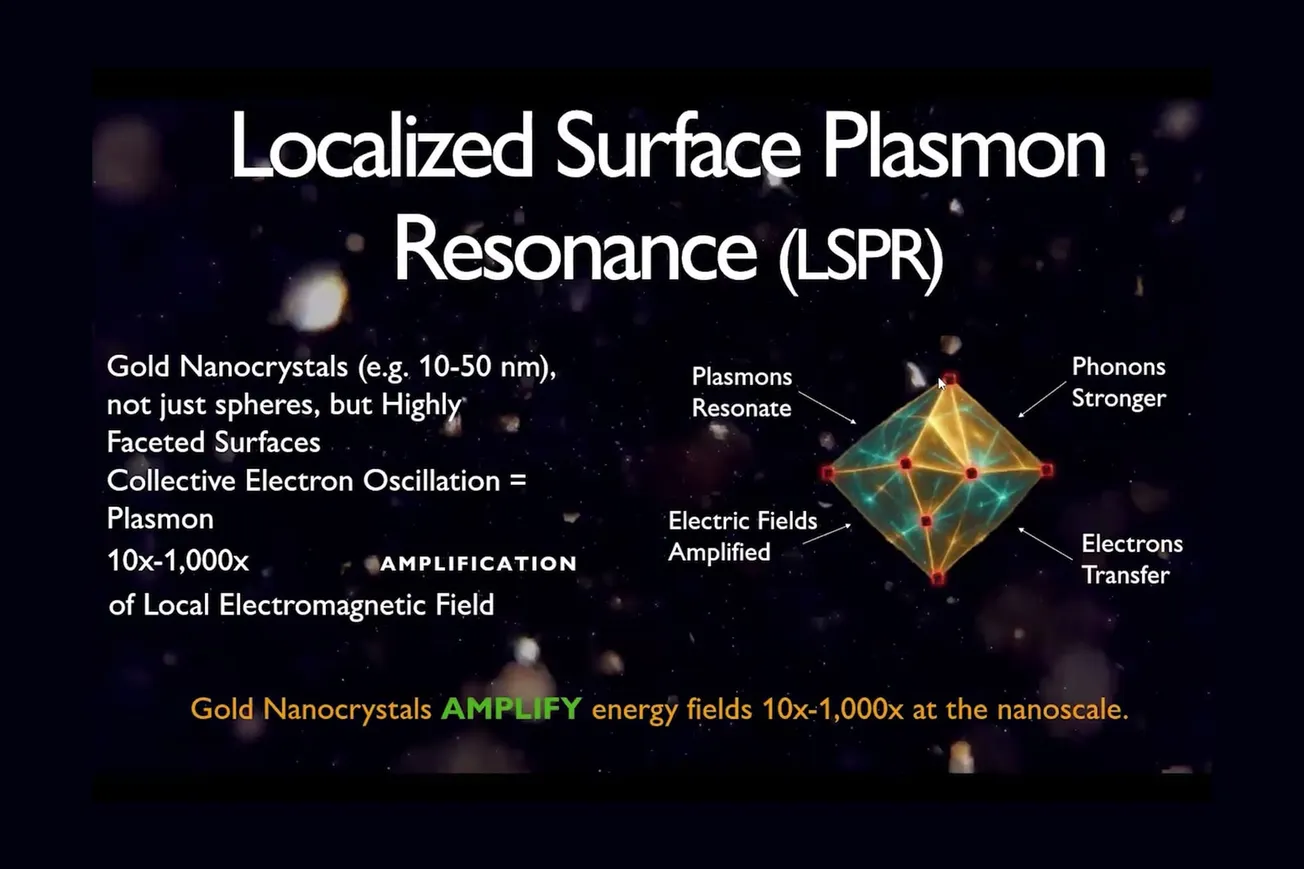
During COVID, lateral flow kits produced a pink line. That colour came from spherical gold nanocrystals absorbing green out of visible light — localised surface plasmon resonance, at a 520 nanometre emission. Mortenson's insight was that the same spectral signature appears in the electron transport chain of the mitochondrion.
"What I understood at that moment in time was, wow, I've seen catalytic reactions like this before," he says.
So Clene built nanocrystals deliberately faceted rather than spherical — pyramids, hexagons, triangular plates, averaging 13 nanometres — because the edges create hot spots. At those points, Mortenson says, the local electromagnetic field is concentrated around a thousand times more than the incoming wave, against roughly three to five times for a COVID test kit. The result, the company says, is a catalyst that converts NADH into NAD+ without being consumed.
The surface had to be clean, too. Reviewing the nanotoxicology literature around 2010, Mortenson found that toxicity tracked not with particle size but with residual surface chemistry left behind by reduction processes. "The gold nanocrystal per se is not toxic at all," he says. "It was residual surface chemistry."
The regulatory problem, and the argument around it
Clene has completed two studies in ALS: the HEALEY ALS Platform Trial, run across more than 50 centres of excellence under Dr Merit Cudkowicz, and RESCUE-ALS, an earlier proof-of-concept study in Australia.
It missed its primary endpoint. Etherington does not dress this up.
What the company says it did achieve: the secondary endpoint of survival, the exploratory endpoint of delayed time to clinical worsening, and a reduction in neurofilament light. On survival, Etherington cites a 94% risk reduction at six months; on clinical worsening, statistical significance across two separate studies with risk reductions above 70%.
That matters because of what the FDA has already accepted elsewhere. Biogen's gene therapy for SOD1-ALS — relevant to roughly 1-2% of patients — was approved on neurofilament light despite missing its primary, secondary and exploratory endpoints. Clene's case is that CNM-Au8 is the first drug in heterogeneous sporadic ALS, the other 98%, to show a statistically significant pre-specified neurofilament benefit in a Phase 2 study.
After five meetings with the FDA in 18 months, Clene says the agency has indicated it is prepared to accept a new drug application, using neurofilament light as a reasonably likely surrogate endpoint for accelerated approval, coupled with a clinical response — survival.
"There's a survival signal here. Let's see if we can build a story." — Mark Mortenson, characterising the internal FDA debate
Alongside this sits EAP-04, which Clene describes as the largest compassionate use programme ever run in ALS, funded by a $45m NIH grant and covering 258 people more advanced than any clinical trial would enrol, now tracked out to four years.
A confirmatory Phase 3 is planned to begin in the coming months — with overall survival as the primary endpoint, which in ALS is itself unusual.
Safety and manufacture
Etherington reports more than 1,100 collective participant-years of exposure and over 900 patients treated, with no related serious adverse events attributed by any clinician. Side effects cited are nausea and headache, described as transient.
Mortenson's explanation is mechanistic: a catalyst promotes naturally occurring reactions and seeks homeostasis rather than pushing a system past it. "The gold, if it gets into a system like being perfectly healthy, it doesn't have any jobs to do. There's nothing for it to catalyze. So it just passes out the body."
Manufacturing is continuous rather than batch — gold wire electrodes in flowing water, stripping ions one at a time. "You can't do this in a batch process, because in a batch process, everything's changing every second."
Beyond ALS
ALS is the entry point because of the speed of its devastation — roughly 35,000 patients in the US, with many dying within two to five years. But Clene is preparing a Phase 3 in multiple sclerosis with the same asset at the same dose, a population of around 2.6 million worldwide, and has had preliminary discussions with the EMA about running the confirmatory study in Europe.
The underlying claim is broader than any one indication. "No one has looked at the root cause upstream and said, why is the cell dying at the most fundamental level," says Mortenson. "And the answer is because of the lack of energy."
Whether the FDA agrees that the evidence supports accelerated approval is a question that will be answered in review.
CNM-Au8 is investigational and has not been approved by the FDA or any other regulator. Clinical and regulatory statements in this piece are Clene Nanomedicine's own, made by its executives in interview. Nothing here is investment advice.
Coming up: Cell & Gene Leaders Live, Sun 15 Nov at The Shard · London Life Sciences Week Guide, 15–19 Nov 2026 ·



Comments