
Table of Contents
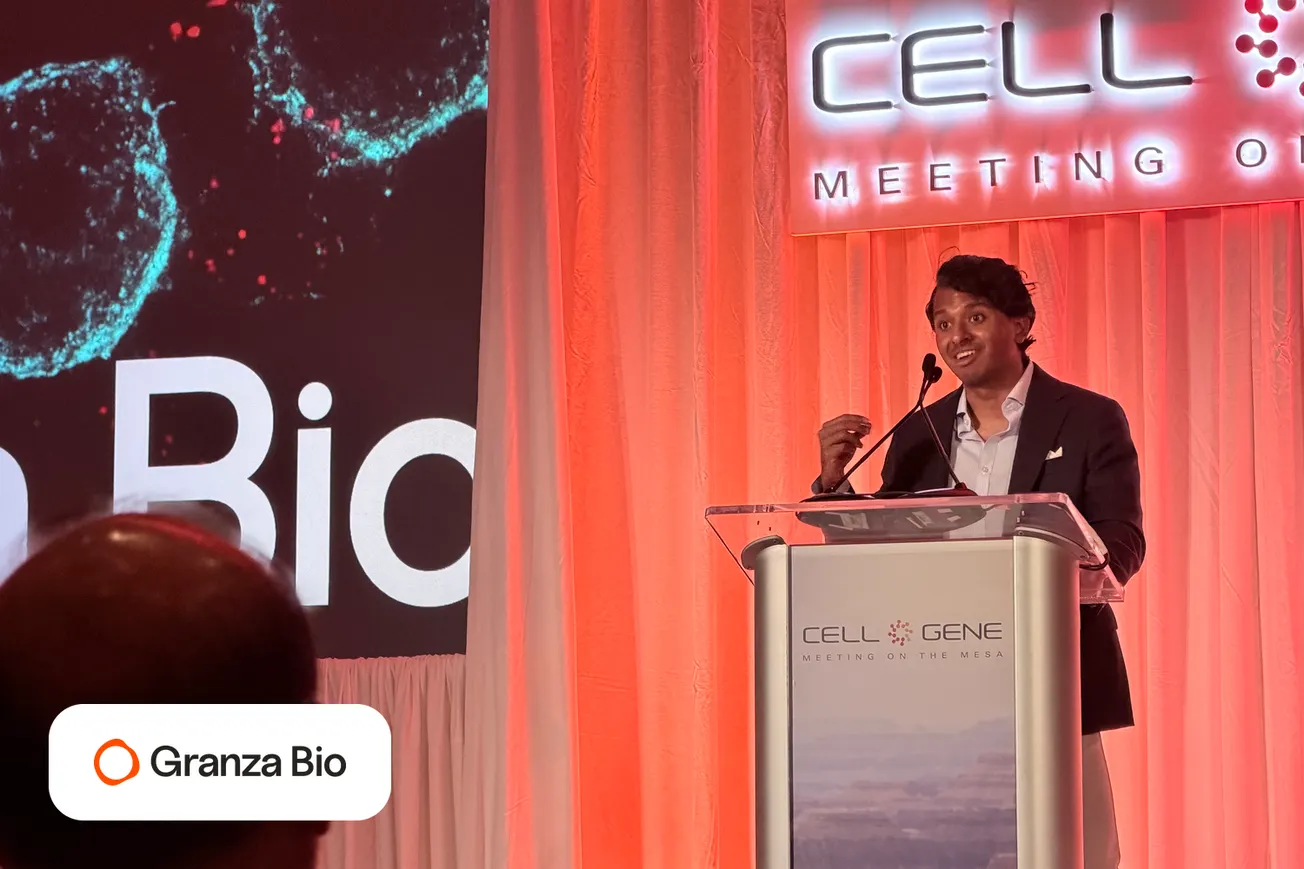
Granza Bio is combining the T-cell “attack particles” behind its SMAP-T platform with a CAR-T approach, delivering CAR mRNA and an mRNA that drives attack-particle production to T cells in a single targeted particle, co-founder and CEO Ashwin Nandakumar said in an Innovation Spotlight presentation at the Cell & Gene Meeting on the Mesa in Phoenix on Tuesday, October 6, 2026.
Nandakumar said the company’s science rests on supramolecular attack particles, or SMAPs, which carry multiple doses of cytotoxic proteins such as granzymes and perforins inside a glycoprotein shell. Co-founder Michael Dustin’s lab at the University of Oxford described the particles in a paper published in Science in 2020. Nandakumar called them a “super-lethal dose in which T cells kill”. All of the data presented were preclinical and company-reported.
According to Nandakumar, the company’s research shows that T cells with a more effector memory-like phenotype produce SMAPs. These cells “have previous experience with an antigen, and they know that they need to kill, and they need to make a rapid attack”, Nandakumar said, and switch their killing machinery from single-core granules to SMAPs.
In company studies, purified SMAPs improved tumor cell killing in a dose-response manner in vitro and controlled tumor growth when injected in vivo, Nandakumar said, and acted as autonomous killers.
To turn that biology into a medicine, Nandakumar said, “we are combining this SMAP armory together with a CAR T approach”, using a targeted particle “where we co-deliver both the CAR mRNA and the SMAP biogenesis mRNA”. A slide shown during the talk described Granza as “building in vivo T cell reprogramming medicines”.
Once the CAR recognizes a tumor cell, Nandakumar said, the T cell shifts toward releasing SMAPs. With the SMAP pipeline, Nandakumar said, “we’re trying to skew the phenotype into that mode of killing.”
In the company’s tests, adding SMAP biogenesis to a CD19 CAR improved killing compared with a classical CD19 CAR, Nandakumar said. Granza has also added targeting motifs to the SMAPs themselves. “When you add in a CD19 targeted SMAP onto the CAR T’s, it improves the killing even further,” Nandakumar said. The company has also tested a CD22-targeted SMAP alongside the CD19 CAR.
Nandakumar said research has shown that CAR-T cells primarily kill through a pathway that releases inflammatory molecules, draws in macrophages and increases cytokines. Granza wanted to know whether SMAPs “would cause similar toxicities”, Nandakumar said, and found that “SMAPs induce a caspase-3 mediated killing, which is an apoptotic form of killing.” Nandakumar said the company is now quantifying the cytokines and chemokines that SMAPs release.
“Any T cell program is only as good as its targeting,” Nandakumar said. The company found that uptake through a single receptor was not efficient enough to deliver its machinery, Nandakumar said, so it engineered a new approach combining several targeting antibodies. Nandakumar added that the ratio of CD4 to CD8 cells targeted is important for building a long-lasting response.
Nandakumar said SMAP-T armoring “can be complementary to many different technologies”, and that Granza is “very keen” to explore opportunities with partners that want to use it with their own RNA, DNA or viral modalities.
About Granza Bio
Granza Bio is a privately held, San Francisco-based biotechnology company founded in 2024 by researchers from the University of Oxford: CEO Ashwin Nandakumar, chief scientific officer Ashwin Jainarayanan and Dustin, a professor of molecular immunology at Oxford. The company’s conference listing says it is developing therapies that reprogram T cells in vivo against difficult-to-treat solid tumors.
The 2020 Science paper reported that SMAPs are rapidly released from cytotoxic T cells and are autonomously cytotoxic, with a cytotoxic core surrounded by a thrombospondin-1 shell about 120 nanometers in diameter.
In July 2024 Granza announced an oversubscribed $7.14 million seed round led by Felicis and Refactor, with participation from Y Combinator. At the time, Dustin said attack particles “offer the power of cellular therapies with the off-the-shelf ease of antibody-based drugs.”
Sources: Granza Bio Innovation Spotlight presentation, Cell & Gene Meeting on the Mesa, October 6, 2026; Cell & Gene Meeting on the Mesa agenda and presenter listing; Granza Bio website; Granza Bio press release, July 10, 2024; Bálint et al., “Supramolecular attack particles are autonomous killing entities released from cytotoxic T cells,” Science 368, 897-901 (2020)
Coming up: Cell & Gene Leaders Live, Sun 15 Nov at The Shard · London Life Sciences Week Guide, 15–20 Nov 2026


Comments