
Table of Contents
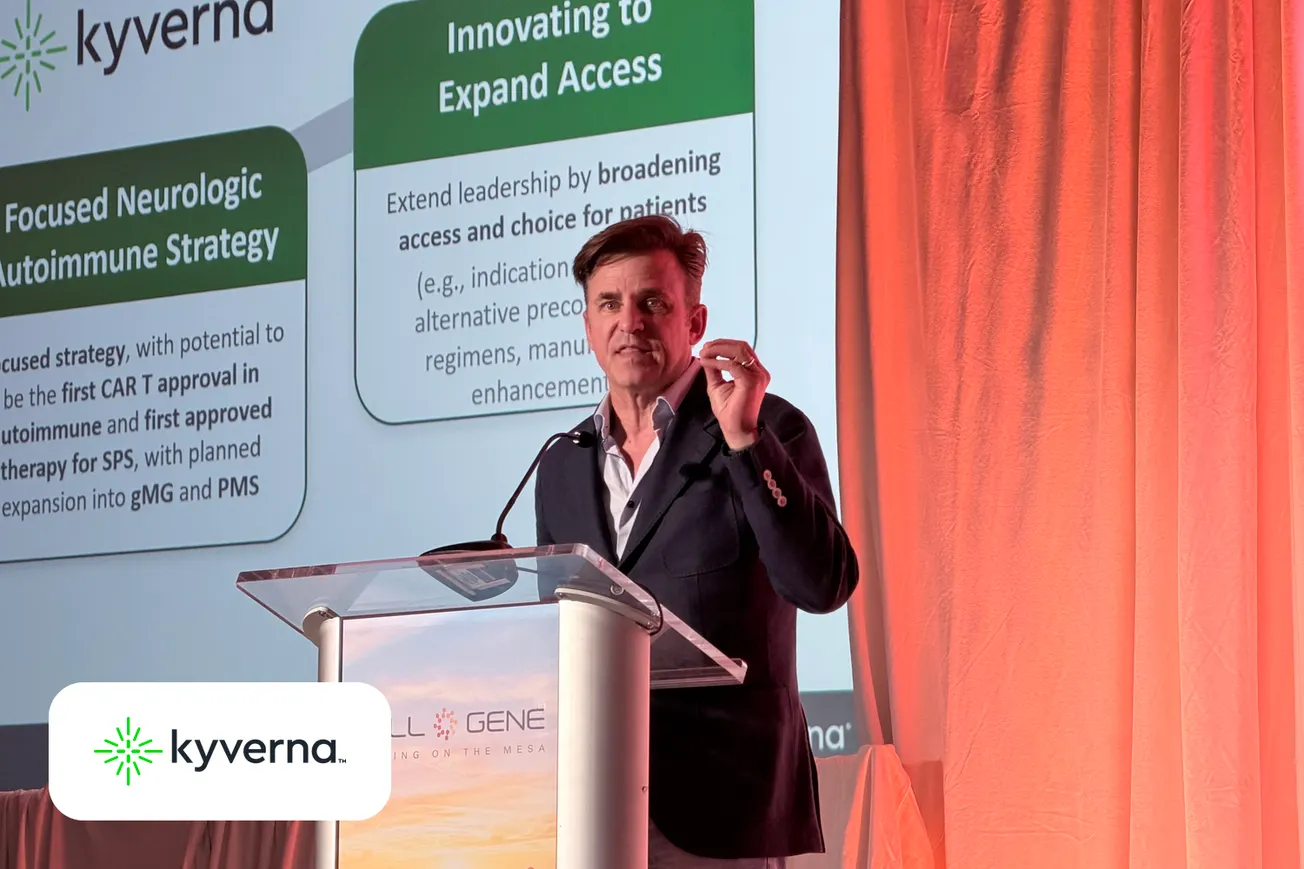
Kyverna Therapeutics expects to complete its rolling Biologics License Application for miv-cel in stiff person syndrome in the fourth quarter of 2026, putting the company on track to be launch-ready in 2027, CEO Warner Biddle said in an Innovation Spotlight presentation at the Cell & Gene Meeting on the Mesa in Phoenix on Monday, October 5, 2026.
Biddle described miv-cel (mivocabtagene autoleucel, KYV-101) as an autologous CD19-targeted CAR T-cell therapy with a CD28 co-stimulatory domain and a fully human design. A slide shown during the talk said miv-cel has the potential to be the first CAR T approval in autoimmune disease and the first approved therapy for stiff person syndrome (SPS), with planned expansion into generalized myasthenia gravis (gMG) and progressive multiple sclerosis. All clinical data presented were company-reported.
Biddle said 80% of SPS patients lose their mobility over the course of the disease, and fewer than 20% remain employed four years after diagnosis. “If you look at the natural history of this disease, patients don’t get better, they just get worse,” Biddle said.
In the registrational Phase 2 KYSA-8 trial, Biddle said, patients given a single dose of miv-cel took a median 49% less time on the timed 25-foot walk test at 52 weeks, against a 20% reduction considered clinically meaningful. About one-third of patients reached a normal walking speed, and two-thirds of those who needed a walking aid at the start of the study no longer needed it, an effect sustained to 52 weeks, Biddle said. Biddle showed one patient, a 39-year-old man, whose walk time fell from 17.3 seconds at baseline to 5.3 seconds at 52 weeks.
“So we’re doing something fundamentally different here, not just treating the clinical symptoms, but in a sense actually reversing the course of disability,” Biddle said.
Biddle said SPS affects about 6,000 patients in the US and that Kyverna will initially target 10 SPS centers that already manage these patients and have CAR T expertise. Biddle said a “dual manufacturing strategy” was “now allowing us to achieve over 98% manufacturing success rate”, and that a recent commercial agreement with ElevateBio would support the SPS launch and an initial launch in gMG.
Across more than 100 patients treated with miv-cel, Biddle said, the company has seen no high-grade cytokine release syndrome or ICANS and no cases of IEC-HS.
In gMG, Biddle said longer-term follow-up from the Phase 2 portion of the KYSA-6 trial showed reductions at 52 weeks of 8.2 points in MG-ADL score and 12.8 points in QMG score. Five of the seven Phase 2 patients had reached one year of follow-up, the company said on September 24. Many gMG patients take FcRn or complement inhibitors on top of other immunosuppressive therapies, Biddle said, adding: “This is costly. This is very burdensome for patients.” Phase 3 enrollment is on track to finish by mid-2027, Biddle said.
Biddle pointed to investigator-initiated trials of miv-cel in progressive MS at Stanford and UCSF, which Biddle said had shown stabilization in disability scores (EDSS) in all patients and improvement in the majority. “Most clinical development programs are looking at slowing the progression of the disease and they see that as a win,” Biddle said. Kyverna has received RMAT designation for non-active secondary progressive MS, its third RMAT designation, and plans to share its development strategy in early 2027, Biddle said.
About Kyverna Therapeutics
Kyverna Therapeutics (Nasdaq: KYTX) is a late-stage clinical immunology company headquartered in Emeryville, California. The company says it has begun its rolling BLA for miv-cel in SPS, has submitted the chemistry, manufacturing and controls module, and plans to seek priority review under its RMAT designation.
On September 24, 2026, Kyverna reported one-year topline data from KYSA-8 in 26 patients, with 92% remaining free of chronic immunotherapies for SPS, and said the data will be included in the BLA and presented at MS Toronto on October 21-23, 2026.
Kyverna reported $199.4 million in cash, cash equivalents and marketable securities as of June 30, 2026, which it said, with amounts available from its Oxford Finance loan facility, would fund operations into 2028.
Onyx previously covered Kyverna’s KYSA-8 topline results and 2026 strategic priorities, and interviewed Biddle at Jefferies.
Sources: Kyverna Therapeutics Innovation Spotlight presentation, Cell & Gene Meeting on the Mesa, October 5, 2026; Cell & Gene Meeting on the Mesa agenda and presenter listing; Kyverna Therapeutics pipeline page; Kyverna Therapeutics press releases of September 24, 2026, August 11, 2026 and July 27, 2026 (with ElevateBio), filed with the US Securities and Exchange Commission
Coming up: Cell & Gene Leaders Live, Sun 15 Nov at The Shard · London Life Sciences Week Guide, 15–20 Nov 2026


Comments