
Table of Contents
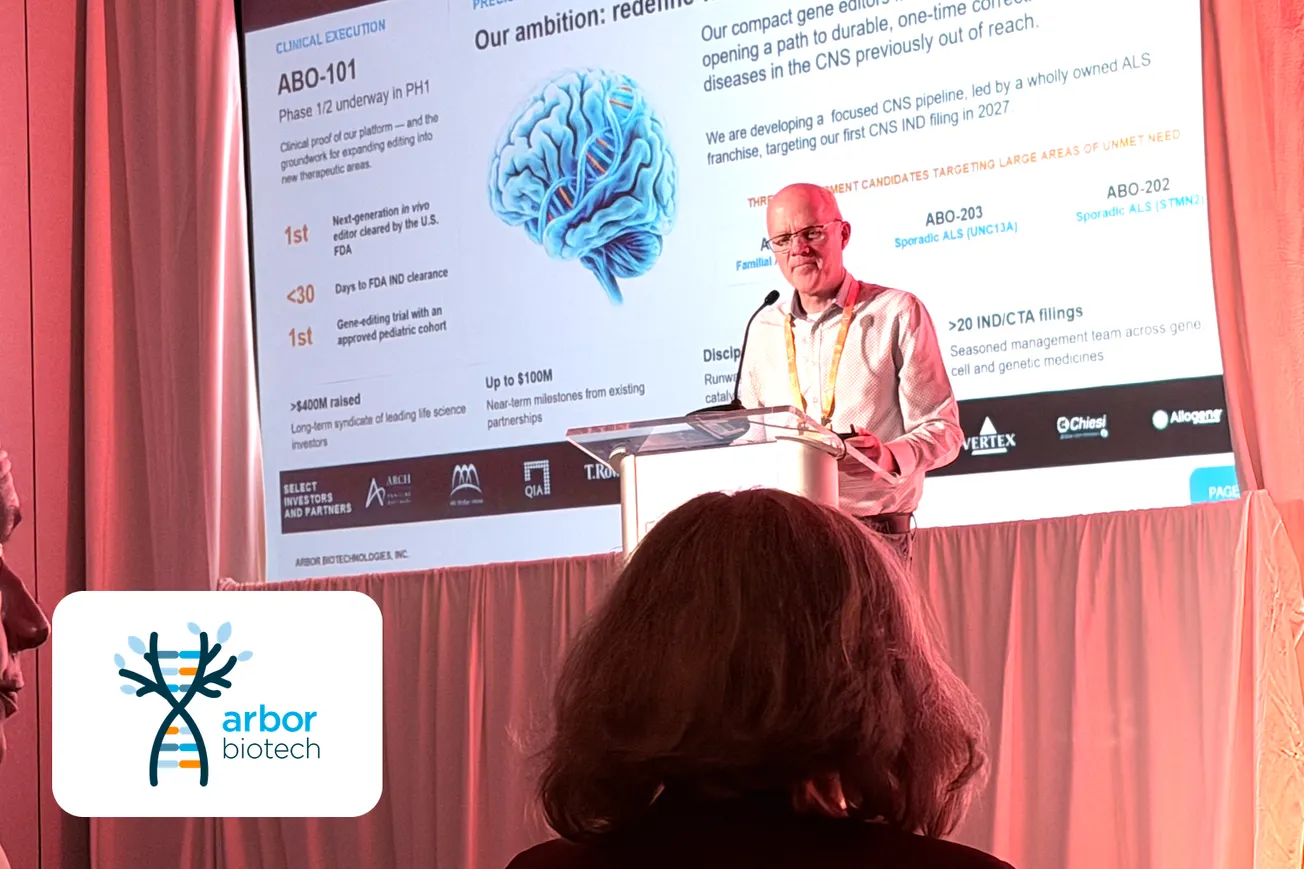
Arbor Biotechnologies used its Innovation Spotlight slot at the Cell & Gene Meeting on the Mesa in Phoenix on Monday, October 5, 2026 to position itself as a central nervous system company, with CEO Devyn Smith walking through three gene editing candidates for amyotrophic lateral sclerosis (ALS) and the preclinical data the company says support taking them toward the clinic.
“We are a gene editing company – the only gene editing company actually laser focused in on the CNS at this time,” Smith told the room, arguing that a wider set of genetic targets, clearer development paths and AAV capsids able to deliver broadly to the brain make this the moment to take editing into neurodegenerative disease.
The lead CNS program targets C9orf72, where a hexanucleotide repeat expansion is a major genetic driver of both ALS and frontotemporal dementia. Arbor’s approach is to cut the repeat out. The company said it has seen at least 40% repeat excision in a humanized mouse model, along with a reduction in the antisense RNA foci that build up in cells and become toxic. Earlier antisense oligonucleotides against C9orf72 did not work, Smith said, primarily because the repeat produces both sense and antisense transcripts and those drugs could only hit one.
The other two candidates go after sporadic ALS, downstream of TDP-43 loss of function. When TDP-43 leaves the nucleus, cryptic splice sites are exposed and key neuronal proteins are truncated; Arbor is targeting the two it described as most affected, stathmin-2 (STMN2) and UNC13A. For stathmin-2, the company said its nuclease excises the cryptic exon, and reported editing of upwards of 40% in a humanized mouse model, which it said restored the protein to wild-type levels.
Smith argued that a one-time edit should compare well with antisense drugs, describing them as dosed repeatedly into the spinal fluid and unable to achieve complete knockdown in any given neuron. “In the case of a gene edit, it’s a binary event. You either edit and fix the neuron, or you don’t.”
Delivery was the other focus. Arbor showed non-human primate data using intravenously dosed, blood-brain-barrier-crossing capsids, with editing levels in neurons that Smith described as “well above what our targets are”. “We don’t believe anyone has shown this type of editing data in a monkey before,” Smith added.
Beyond ALS, the company outlined two platform advances. The first is a compact nickase and reverse transcriptase pairing that the company put at about 3.4 kb, against roughly 6.5 kb for a Cas9-based equivalent, which it said is small enough to fit with its guides inside a single AAV. Arbor said it has seen editing in mouse liver, heart and brain with the system, which underpins an Alzheimer’s program designed to convert APOE4 to an APOE3 phenotype. The second is an all-RNA approach to large insertions, intended to be delivered in a single lipid nanoparticle, which the company said can rewrite up to 800 base pairs, with efficiency declining as the insert gets larger.
“If we really want editing to be a modality, we need to treat it as such, which means you need to have a toolbox of approaches that you then test to find the right tool for the right target,” Smith said.
The ALS programs are intended to answer three questions in the clinic: “One, can you dose an AAV gene editor safely? Two, do you see editing in biomarkers that we can test in the CSF? And then three, is there a clinical outcome that’s positive?”
A slide shown during the talk said Arbor is targeting its first CNS IND filing in 2027. All of the CNS data presented were preclinical and company-reported.
About Arbor Biotechnologies
Arbor is a clinical-stage gene editing company based in Cambridge, Massachusetts, co-founded by CRISPR pioneer Feng Zhang. Its most advanced program, ABO-101, is a lipid nanoparticle-delivered Cas12i2 editor designed as a one-time treatment for primary hyperoxaluria type 1 by knocking out the HAO1 gene in the liver. It is being tested in the Phase 1/2 redePHine study and is being developed in collaboration with Chiesi Group; the European Commission granted it orphan drug designation in June 2026.
On its pipeline, Arbor lists the three ALS candidates as ABO-201 (C9orf72), ABO-202 (STMN2) and ABO-203 (UNC13A), all AAV-delivered, alongside the APOE4 program ABO-206. Allogene Therapeutics also uses Arbor’s editing technology in its allogeneic CAR T candidate ALLO-329 for autoimmune disease.
The company raised a $73.9 million Series C in March 2025, led by ARCH Venture Partners and TCGX. In May 2026 it reported precise reverse transcriptase editing in the mouse brain using a single AAV vector. Slides shown at the meeting put the total raised to date at more than $400 million, with up to $100 million in near-term milestones available from existing partnerships.
Onyx previously spoke with Smith at Cell & Gene Meeting on the Med 2026. You can watch that interview here.
Sources: Arbor Biotechnologies company presentation, Cell & Gene Meeting on the Mesa, October 5, 2026; Arbor Biotechnologies pipeline; Arbor Biotechnologies press release; Chiesi Group and Arbor Biotechnologies press release


Comments