


Table of Contents
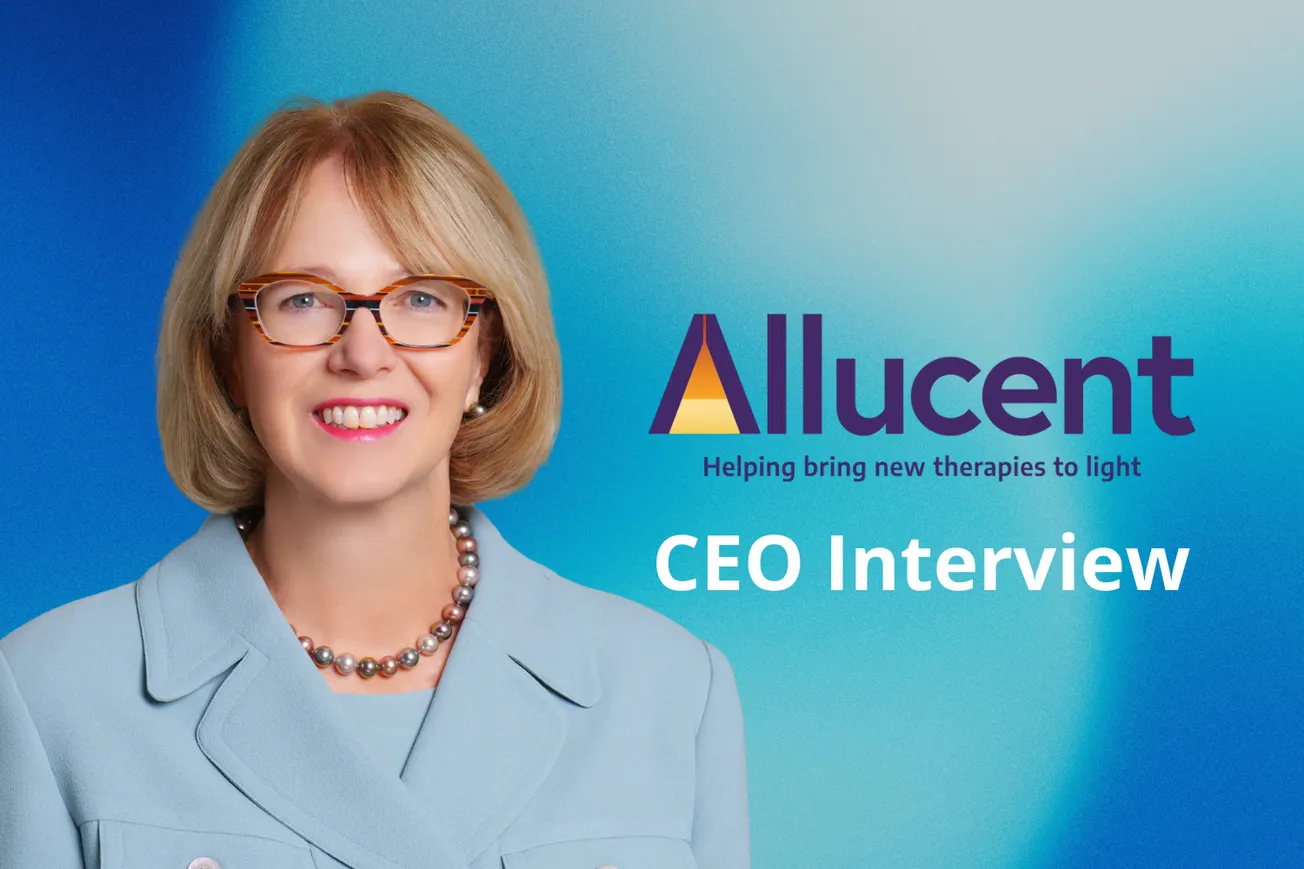
You can read our first interview with Paula Brown Stafford, from December 2024, here.
It's been a year since we last spoke. What single development over the past year has most clearly validated Allucent’s model, which is focusing on smaller, scrappier, emerging biotechs?
Well, it's hard to find just one - so let me give you three. I think there is a sustained demand from biotechs, which we’ve been seeing through the latter half of this year.
Despite the ongoing capital crunch across the sector, interest in partnering with Allucent has continued to increase. Sponsors are looking for partners who understand their constraints and can still help them to move efficiently. That continued pull from the market is really a strong validation of our model.
The second is that, again in 2025, we are regularly competing with, what I call, ‘the Bigs’; those who people consider to be the top tier CROs.
The fact that we are in the same competitive set - and winning fairly consistently - reinforces that emerging biopharma companies see the value that we deliver and consider Allucent as a true contender in the global CRO landscape.
And I emphasize global, because a lot of small CROs are in one or two countries. Our global presence really puts us in contention with the top tier.
The third thing that I'll mention, over the past year, is just the growing volume of what I would call ‘rescue’ work. Different people have different names for it, but, really, it’s where a sponsor has been dissatisfied with their current provider - often one of the ‘Bigs’. We have done this type of work before, of course, but we've seen an increase over the past year.
There's often been some high level of fatigue with the sponsor on a particular project. It really is a white glove-type of service; one that means that we can restore their confidence and help them deliver results. We've had a steady flow of that rescue work, which really shows the trust that biopharmas are placing in Allucent to deliver when it matters most.
Looking at your clients, which therapeutic areas are generating the greatest amount of demand and interest?
We're seeing a lot of demand in oncology. People also talk about rare diseases. To me, rare disease equals precision medicine, which means personalized therapies.
We have a lot of expertise at the intersection of rare disease and oncology. That’s an intersection that has really emerged over the last 12 months. So, in terms of our success in those rare and ultra small population studies, it depends greatly on finding the right patients. We think about it as the needle in the haystack, but we have a large haystack by being global.
We've really drawn on the help of patient advocacy groups, and on specialized networks that we've partnered with, to make sure that we can deliver in these rare and precision medicine areas. I would say precision oncology is what has been growing the most.
For rare disease work, how much of a limiting factor is identifying patients?
We're going to see more of this, and we are using data to try to pinpoint, but also call upon the help and expertise of patient advocacy groups.
Are we finding it harder? I don't know that it's harder. Not everybody wants to do rare disease work because it is hard. But that is where Allucent has really put its thumbprint, and why people come to us; precisely because these are not quick burn studies. It's not your GLP 1.
Our thumbprint is on rare disease precisely because of our ability to find these patients. We have a lot of expertise in a lot of therapeutic areas, and rare diseases, that we’ve worked on. That’s, in part, where our internal database comes into its own. We know where the sites are that have previously allowed us to recruit those patients.
So, rare disease is hard, but I don't know whether it's gotten harder. I think we feel confident in our ability and in what we've been able to provide in this space.
Internally, have you been leveraging this new technology to enhance your workflows?
We do consider ourselves a tech-enabled CRO, and we use both our internally developed AI tools and also external data sources; both of which have really strengthened our feasibility assessments.
At the end of the day, what we're trying to do is recruit patients for our customers. To do that, we need to look at inclusion and exclusion criteria and align the protocol with the standard of care across different countries. Using our AI tools, we're better able to assess that feasibility internationally.
They also help us to understand how to match up the protocol with these rare and ultra small populations, because, while the standard of care is different, you must have one protocol for all. So, the tools help to process all that information and help us to deliver on those feasibility assessments.
There's been a lot of talk recently about the lack of funding for biotechs. How have Allucent managed with the margins and revenues, and what impact have you seen on your clients?
In 2025, we have been steadily making up for the government work that really tapered off earlier in the year. So, our business has changed a bit, in terms of our customers. We are seeing a lot of interest in ballparks from them. The fact that we're invited to the table again is just validation of what we provide.
In terms of the revenue mix and the biotech funding, the biotech funding is coming around, but it is really a question of their cash on hand. They may have the funding, but the cash may not be easily accessible. So, we are partnering with them in an incremental way, to help them. This is where we can adapt and be nimble because of our size, to help them to get to that next stage, incrementally.
I may have shared this with you before, but you really can't bring a patient into a trial if you don't have the money to finish it. But you can do everything prior to that point. Collectively, we have to make sure that our customer - the sponsor - has the funds to see it through to completion, once they recruit that first patient.
So, we contract with them incrementally. Our backlog follows that logic, so there aren’t any surprises. And, when the sponsor’s cashflow allows, then we can start work and the cash follows.
But we have had customers start, only to have difficulty finding the cash and have to stop, hold or delay. Sometimes, those are funding issues; sometimes they can be regulatory; sometimes, it’s that the product isn’t ready in time to start their clinical trials. We've seen all those examples in 2025.
With smaller biotechs, we’re often seeing longer fundraising cycles. What's your approach to managing contract risk and cash flow in that context?
Well, it comes right back to the incremental nature of the workflow, so that we aren't at risk. And that incremental contracting, and additions to backlog, has allowed us, through our nimbleness, not to be caught off guard.
We're expecting talk of a consolidation wave in the mid-tier CRO market. How do Allucent plan to position themselves?
The main word is focus. We are focusing our investment in experienced talent across our core ACEs, A.C.E. for Allucent Centers of Expertise. Our core ACEs are oncology, neurology, and infectious disease.
We’re focusing on those three. Investment is continuing; by adding to our tech enabled capabilities, and really delivering that global aspect that we have, alongside our long history in rare disease. We’re positioning ourselves to be the right partner for emerging biotech customers, because big pharma isn’t investing as much in the early-stage drug development path.
You've seen Lilly and J and J, this year, in terms of their own acquisitions in that phase one, two, and early phase two space. I think they're going to continue to do that, and they are going to look for quality partners with quality data. With our expertise in that early phase, we also do late phase studies. But within that expertise, we have had two of our sponsors, in the last couple of months, who have partnered with ‘Bigs’, after our role was finished.
So, there's just going to be more of that. I think that it positions us well, in terms of expanding those capabilities and continuing to focus on those areas. I also think we are well positioned to thrive, as any consolidation accelerates in that mid-tier sector.
What are your main priorities for 2026?
It's really focusing on those three areas, which are oncology, neurology, and infectious disease. And on the talent that we add to our team. It's focusing on continuing our use of AI and data. Really, it’s just going to be continuing to ensure that we’ve a global footprint.
Are there any strategic partnerships or minority investments that have taken place over the past year, or that we can perhaps look forward to?
Well, we are approaching partnerships with intention and vigor for each area that's outside of our core expertise. We have identified two or three partners. We’ve qualified them so our sponsors understand that choosing us also means choosing partners whose work meets our standards and had our full confidence. All of this is delivered through a streamlined, coordinated process with Allucent.
So, we haven't announced any new partnerships, but we do have some new partners in 2025, that we'll take into 2026 in some of the service areas, as well as site network partnerships.
This great technological transformation means that we're seeing a shift from the traditional clinical trial to newer more adaptive designs utilizing AI. How do you hope that Allucent is going to contribute to this next chapter of the biotech industry?
Yeah, I'm excited about how we will contribute! It starts with a drug development, or product development strategy, and helping our customers with our regulatory and clinical pharmacology expertise; being able to help them with that strategy and then bringing in adaptive designs. It goes back to the expertise that we have, and we'll continue to build upon within our three core ACEs.
We will continue to build upon those with the AI as a teammate, because we need to. However, we still need our team to have their own expertise at asking the right questions and providing solutions to our customers.
In terms of adaptive trial design, yeah, we’ll continue. We've recently added to our biostatistical consulting group, to partner with our regulatory group in those protocol design phases.
Help me understand something from your perspective, within the world of CROs. Let's say, for instance, a company like Avidity, who were acquired about a month ago. They're working on rare diseases. They're at phase 2 and they're acquired by Novartis. Are they likely to continue with the same CRO for phase 3 or does big pharma bring it in house? What happens?
I've seen it go both ways over the years. It depends where the expertise is because if Novartis is buying a rare disease, one for which they don't have the scientists or the clinical team on board, then they're better served continuing as it previously was.
We have two recent sponsors of ours who have partnered, and, so far, they have asked that we continue, because they still need time to build their own internal expertise for some of these products that they have acquired.
It just depends on what they have internally, and how close to their own portfolio what they acquired is. If it's outside their current portfolios, they're going to need to keep some partners for a while.
But if it's in their wheelhouse, then it will go more quickly. Usually, we find that it’s not in their immediate capabilities. When they acquire these products, they don’t always have a bench ready and waiting. We’ve all seen a lot of big pharma, small pharma, big CRO, small CRO doing layoffs this year, right?
So, often, it's a portfolio prioritization exercise. I've seen, in my 40 years in this industry, people buy products and do nothing with them, because they just don't want a competitor on the market.

Comments