


Table of Contents
Could you start by introducing yourself: who is Slone Partners and what are you working on?
First, I want to thank you for inviting me for this interview. It’s a pleasure to speak with you about our company and the many clients we support.
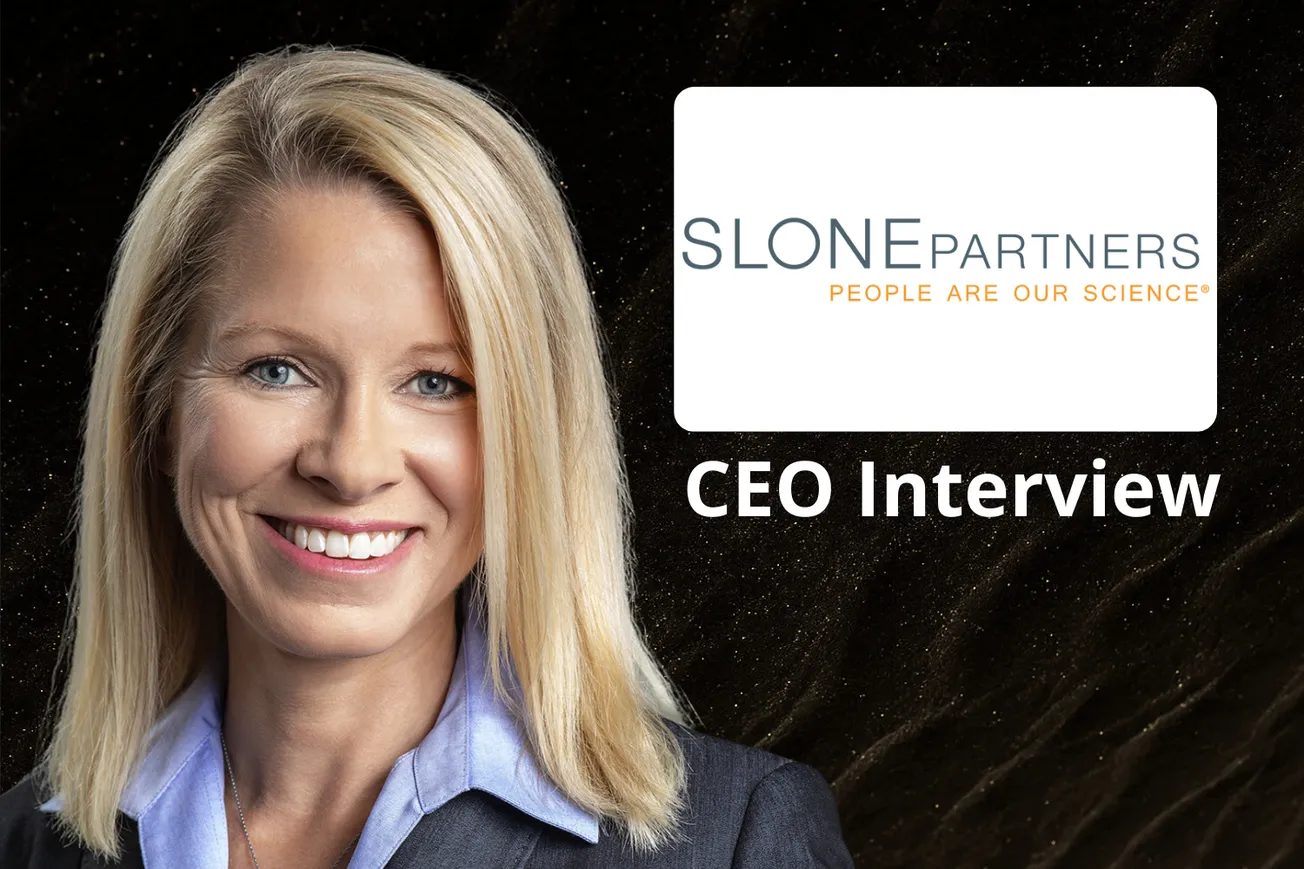
I’m Leslie Loveless, CEO and Managing Partner at Slone Partners. I’ve been with the firm for just over 19 years. The firm has been in business for more than 25 years. I moved into the CEO seat in July 2016, so I’m coming up on 10 years as CEO.
Our focus as an executive search firm is supporting life science and healthcare companies that are seeking visionary leaders in a very competitive market. We’re a boutique firm with a specific focus in life sciences and healthcare, but we work broadly across both industry sectors.
We work on behalf of for-profit biotech, tools, diagnostics, data sciences, pharma services - as well as healthcare: medical devices, med tech, digital health, clinical services. We also support healthcare institutions, including academic medical centers, hospitals, and health systems. We enjoy working with all these clients.
I consider us generalists in the sense that we work across all these sub-sectors and all functional areas, but specialists in that we’re very dedicated to those two industries, life sciences and healthcare. We love the work we do, and we have a lot of longevity in our team. It’s very common to find a Slone Partners employee who’s been here 10 or 15 years.
Thinking more specifically about your biopharma clients, what trends and changes over the past couple of years have affected the industry, specifically the type of leadership that companies are looking for?
I’ll start with what we already touched on - the difficult funding cycles of the last couple of years. It’s been tough on both leaders and companies alike, but it has reinforced that companies need to hire leaders who can do more with less.
What I mean is being able to run lean teams and consider alternative team structures. In 2024, Slone Partners launched our fractional talent service line which delivers experienced executives and functional experts who provide strategic guidance on a flexible, part-time, and/or project-focused basis. A lot of clients are looking for novel ways to staff their company in the early days when they’re lighter on funding but still need to get to key milestones.
There’s also a need to operate with greater agility. We’ve seen a lot of companies make decisions about their assets - which programs will continue and which won’t - and focus on the best possible outcomes when you have a lean budget. These are hard choices, and leaders have to make them, often without all the data they would like to have.
Along with tighter funding cycles, we’re also seeing a change in where investors are investing. There’s been a shift from early-stage discovery-type companies to greater investments in clinical-stage companies or companies with assets that are close to the clinic.
That means we’ve seen more hiring focused on clinical-stage assets. We completed many searches for Chief Medical Officer (CMO), Chief Development Officer (CDO), Vice President: Clinical Development, and Vice President: Clinical Operations - roles that are geared toward moving clinical assets. That is a shift we have seen in the last couple of years.
The last item I’ll mention is technological advances. Those affect what clients are looking for when they hire executives. You can use technology to impact trial design - cost, speed, patient stratification - so clients want executives who are tech-savvy.
On executives who are tech-savvy - and the founder/CEO question - how do you make that call for your clients whether it should be science-driven or more business-minded leadership?
This is a really important question, and it’s very relevant to the work we do at Slone Partners because many of our clients are early-stage, venture capital-backed. Commonly, we’re coming in at Series A, so these conversations are happening early: what does the future look like and who is the leader for the future?
It’s critically important to bridge the gap between science and commercial viability. There’s lots of great science, but great science doesn’t always translate into something commercially viable.
So, you need leaders who can bridge that gap and bring it all together with a compelling strategic plan as to how the product will be commercially viable or what its position in the market will be.
Whether the scientific founder can do that depends on their strengths and gaps - sometimes they can and sometimes they can’t.
It comes down to whether a founder can transition from the hands-on science role to defining business strategy, commercial strategy, raising capital, and building the organization including a hiring plan. They have to go from bench work and science to all of those skills.
Some founders are excited by that step. Many founders are not, because they love the science and want to stay focused on the science. So, self-awareness is hugely important - being aware of what you love to do, what you’re great at, and having transparent conversations with your board and investors.
In the end, everyone wants success. Everyone wants the right outcome for the business and for therapies to reach patients. Being realistic about what you can do well versus where your gaps are - those conversations lead to the right decision.
How do boards and companies decide that you’ve done a good job in picking leadership? What returns and key metrics are they looking at?
We know things are going well when we see movement - assets advancing, a clinical trial going smoothly, and clients saying, “This is exactly what we needed.” They know how to move the assets. They know how to prioritize. They know how to operate lean.
They tell us these things. We watch it happen. We’re in constant communication post-placement with clients and candidates, so it becomes clear when it’s going well.
On the rare occasions when it’s not, we hear that too, and we work with clients to figure out the solution.
Today it’s really about: are we moving the assets? Are we hitting critical milestones that get us closer to commercialization or closer to being an attractive M&A target for big pharma?
As you’ve scaled and look to expand, what systems and decisions are you leaning on to preserve candidate quality while scaling volume?
Scaling is not easy in executive search because we’re connected to what’s happening in the market and the demands coming from the market. Team size and resources fluctuate, and you have to be careful. You don’t want to scale way up and then pull back - you’re talking about human beings and livelihoods.
Most search firms experienced dramatic scaling in 2021 and 2022 and then scaling back down in 2024 and 2025 because the difference in demand was night and day.
Everyone learned a lot from that, about being careful when money is flowing and everyone is hiring and you feel the need to hire too. Looking back, a lot of leaders would probably say they should’ve moved more cautiously because it was happening at such a frenzied pace.
So how do you manage scale with the market? Part of it is technology. Executive search is very labor-intensive. It takes a lot of people.
Technology is getting better, and ironically, we recently went live with our new CRM. It’s much more automated than what we were using.
So, when there’s fluctuation in demand, it won’t mean we’re constantly adding support team members to adjust, because a lot of the sourcing and reporting work we were doing manually is now automated through our system. That helps in an uncertain market.
Culture and values seem very similar on paper or websites. How different are cultures in reality, and how do you match a leader to a client? Does it matter?
It makes an enormous difference.
There’s a balanced approach from clients on competency versus fit with the organization. Values can be similar in terms of the words chosen, especially in small to mid-size companies. They talk a lot about values and believe in living them.
What’s different is how they show up and reflect these values. The definition of a word like “excellence” can be uniform, but how that shows up in day-to-day work can vary tremendously.
You learn the nuances the more time you spend with a client - getting to know people in the organization, how they make decisions, how they communicate, direct-style versus softer delivery. So yes, the words can be similar, but the way it feels inside the organization can be very different.
Do you have a story where you had to swap out an executive?
For sure, after 25 years in the business. It has happened to every search firm, and it will happen again.
You feel the disappointment in the outcome for your client and the struggles they experience when something doesn’t work out. Fortunately, it works out far more often than it doesn’t, but when it doesn’t, it’s hard.
Our philosophy is to get back on a project immediately. We treat it like it’s our first search with that client and show up with focus, because they need that.
One example was a Chief Commercial Officer (CCO) role where the outcome wasn’t what anyone wanted, and it was mostly about fit, rather than experience or competency.
In early-stage companies with limited resources and lean teams, sometimes people come in expecting to only be a leader of people and ideas - not a doer who gets the work done.
In our space, supporting small to mid-size companies, you have to be both: a leader and strategic thinker, and a doer. If you’re not both, that’s a common reason why it doesn’t work out. Honestly, it’s probably the single most common reason.
If I’m a budding VP trying to make the leap to my first C-suite role, what advice would you give?
That is a tough leap for many executives.
One strategy of which I’m a big proponent is having a professional coach. Not everyone in your circle will tell you how it is. A good coach will, and that’s a really important resource if you’re trying to grow.
If you don’t want to grow, don’t ask for feedback. If you do want to grow and make that leap, ask all the questions you can because feedback helps you grow.
We have a joke inside our company about me giving feedback and the team saying I’m trying to give them a gift, because that is exactly what feedback is. Although it doesn’t always feel like a gift.
Having a coach who is there to serve you and help you get where you want to go is smart.
The other thing is self-awareness. It’s hard to achieve because people who are great at what they do can feel like they’re always right. It can take time to realize that isn’t the case.
Creating a space where you can be self-aware, invite others in, be open to conversations, and learn what other people see – this is helpful to maturing as a leader and being ready for the C-suite.
Looking ahead a few years, what would success look like for you at Slone Partners?
I want us to continue to be recognized as a premier executive search firm and talent partner. I say “talent partner” because I feel like we deliver more than executives - we deliver advice, counsel, and market insights.
I’m always talking to clients about compensation trends and titling and position scoping, and what makes sense and what doesn’t.
For me, it’s about being exceptional and a loyal partner to clients. Bringing the right people forward who help clients achieve their goals and get lifesaving products to patients - that’s why we’re all here.
I want our team to be happy internally and love what they do. When the team is happy and working well together, clients feel that. They show up in positive, collaborative ways, sharing wins, and helping each other through tough situations. I want to continue supporting that internal culture.
One last thing - you were an English teacher when you started. What were you teaching?
I love Jane Austen; she’s my favorite author! I enjoy many classics and like seeing them made into films drawing younger generations. I want to go see the new Margot Robbie film, Wuthering Heights.
But, I also love grammar and writing. Those are two of my favorite things, which is very strange because most people hate grammar, but not me. For me, it’s a mathematical problem you have to figure out. There are rules and you apply the rules; that’s the answer.




Comments