


Table of Contents
ADDENDUM
16 December 2025
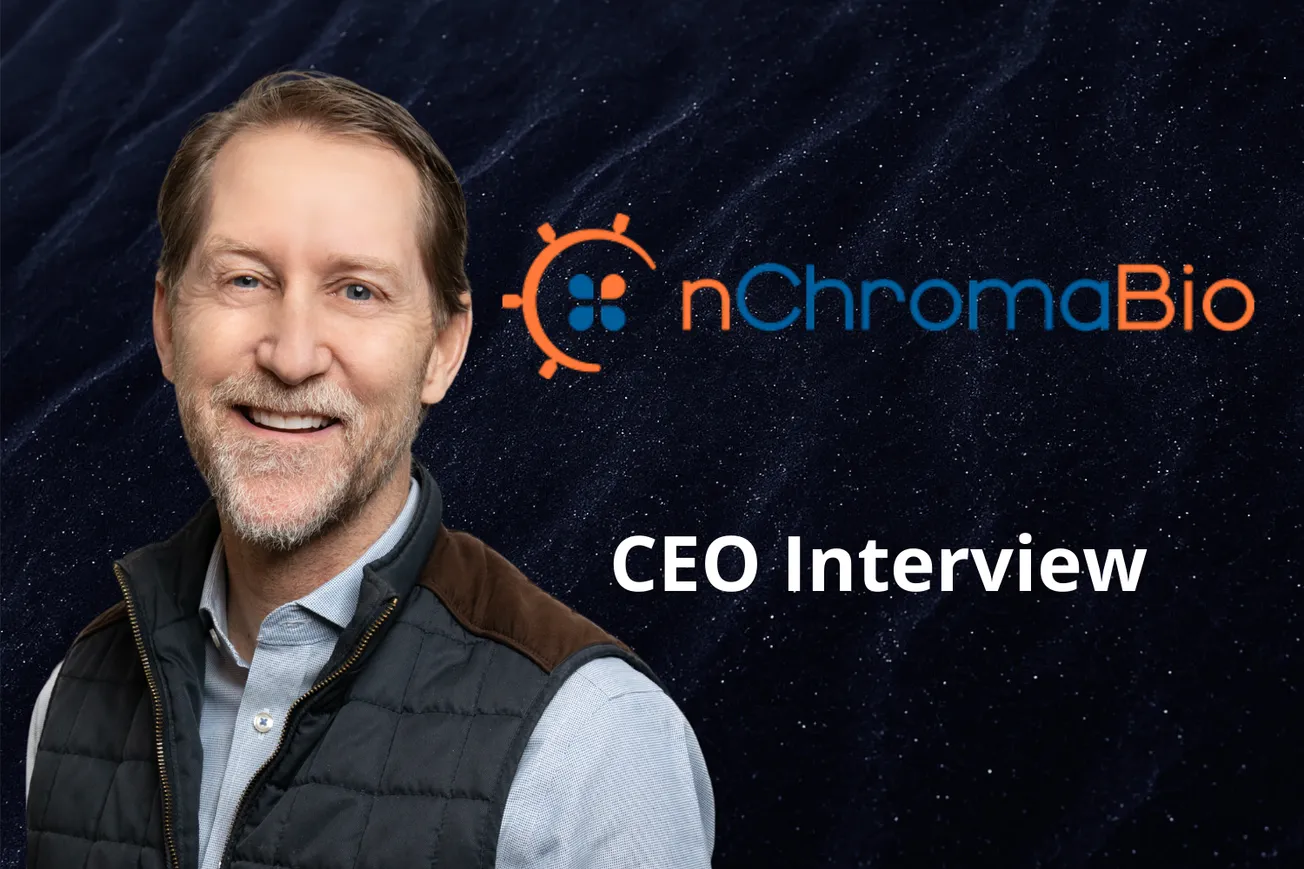
nChroma Bio announced that it has received a Certificate for Clinical Trial in Hong Kong to initiate a Phase 1/2 clinical trial of its lead candidate CRMA-1001 for the treatment of chronic hepatitis B virus (HBV) infection, marking the biotech’s transition to a clinical-stage company. Dosing is planned for Q1 2026.
Read the full press release
Could you summarize your career journey and what led you to become CEO at nChroma Bio?
I’ve spent 35 years in the industry. This is the ninth small company that I've been involved in that spans many different technologies. I guess ‘technologies’ is the right description, because I've done everything from biologics, small molecules, gene and cell therapy, and now, to epigenetic silencing. In the past, I've also worked in diagnostics, drug-device, and even a healthcare technology company.
So, by virtue of being in the field for as long as I have, I’ve definitely seen quite a bit. I think the only common theme to all of this, because it’s quite an eclectic set of experiences that I've had, was that they were all pretty darn cutting-edge technologies.
I'm not a scientist; I'm a businessperson by training. However, for some reason, I'm attracted to technologies that are high risk and high reward, where success truly can change a field. That’s certainly true of nChroma Bio.
I was working at Third Rock Ventures, after 9 amazing years at bluebird, and that gave me a chance to take a step back and take stock of the field. I still wanted to stay within the cell and gene therapy space, broadly-speaking. I came across this opportunity at one of the two companies that ultimately combined to become nChroma, called Nvelop Therapeutics, which was trying to solve the field’s extrahepatic delivery challenge. I thought, if anything, that would be the one I'd like to take a run at. I did and ultimately, we merged with Chroma Medicines, at the end of last year, to become nChroma Bio. Now, we've got a broader set of tools and technologies to pursue, including an exciting near-clinical asset going after hepatitis B.
Your lead program, CRMA-1001, targets chronic Hepatitis B. Could you tell us a bit more about the asset, and what technical steps need to be conquered before moving to the clinic?
Yes, we are very near the clinic. To give you a status update on the product itself, we expect to dose the first patient in Q1 2026. We are in the midst of responding to different jurisdictions’ questions after multiple CTAs have been filed, again, with the anticipation that we'll dose that first patient in Q1.
There isn’t a lot from a technical perspective that we need to complete for these CTAs. What’s ahead is responding to the regulatory questions; getting the green light to move forward with patient dosing; delivering the product to the clinical sites and getting the sites up and running. Those are the steps that we need to take to start testing the thesis of generating functional cures for a population that desperately needs it.
In the context of the merger and the raise, what investments or team changes have you been making to push that asset towards first-in-human testing?
We’re really following the data and letting it drive us toward the right investments, which is always the best way to build a biotech company. With that in mind, over the last year, we've been bolstering our clinical readiness. That involves everything from getting the drug supply ready to be dispatched to sites, on a global basis, to making sure the regulatory team is in place - both the general regulatory folks and the Reg CMC side - and then building out the clinical operations and clinical strategy teams and capabilities, as well.
So, that’s been our focus over the last year and a half, or so, in preparation for these CTA filings. That’s a fairly classic build for an organization entering the clinic. What's unique is that this is a new modality, and the first time that we’re entering human clinical trials with a tremendously promising new approach to gene silencing.
As you can imagine, CMC is one of the big challenges for new therapeutics like this, and something you really have to focus on and get right. The great news is that we've got a product released and ready to be dispatched to these clinical sites. Over the last year, we’ve been through the scale up; the production; and, ultimately, the release of those products to get them to the site. That was a heavy lift, for sure, but that’s now behind us, which is terrific!
Now, it's about getting these sites open; getting patients enrolled; and then, dosing the first patients and having that exciting moment of seeing that first clinical data come out of an endeavor that's been years in the making.
As you're looking to develop that internal pipeline, how do you balance that with looking towards external partnerships?
That is an important question. Before answering that question, let’s take a step back on why there is such interest in epigenetic silencers in general and in HBV applications.
We have always followed the data, and it continued to drive us toward the excitement around CRMA-1001 in the HBV population on a global basis.
There's such a massive unmet need. If you look at the statistics, there are nearly 300 million patients across the globe with chronic HBV. There are over 2 million patients with chronic hepatitis B in the U.S. There are 1.2 million annual new infections, and there are 1.1 million hepatitis-related deaths each year worldwide.
Ultimately, the goal for that population is functional cure. Functional cures with current therapies, and even those in clinical development, have been elusive. LNP directed epigenetic silencers are uniquely suited to address the biologic challenges of generating functional cures for hepatitis B patients.
This gets a little bit more technical, but there are, basically, two different mechanisms driving HBV pathophysiology, cccDNA that acts as a factor in the liver for new viral particles, and integrating HBV DNA in liver cells. You need to be able to hit both robustly. Epigenetic silencers do, in fact, hit both pathways durably and with a potential single course of therapy. That's what allows the potential to deliver one-time, durable, functional cures in this population, which I mentioned has been elusive.
That's why I think not just we, but the biotechnology and pharmaceutical field, generally, is paying close attention and is excited about seeing this clinical data readout. The data from our epigenetic silencing technology is also driving us toward other investments - in cardiometabolic disease, and CNS applications where, again, the data show our preclinical ability to address some pretty meaningful and large diseases.
Partnering will always play a big role in building the company. We have many ongoing conversations across the pipeline, as we likely can’t do this alone and will need both external expertise, technologies and capital to fulfill the full potential of in vivo epigenetic silencing.
If we could speak about the $75 million financing, how much runway does that grant you, and what are your plans for the next raise?
Let’s take a quick step back. Concurrently with the merger of the two companies, we raised $77 million at the end of last year. That capital was intended to get us into mid-2027, so, in other words, through the 2026 and first half of 2027 readout of clinical data on CRMA-1001. That is still the case, today.
That capital also allows us to continue to invest, at the preclinical stage, in the two other areas that I referenced - cardiometabolic disease and CNS. Our intent is to continue to use our capital to build the pipeline by driving more programs toward clinical proof-of-concept and advancing other preclinical programs.
As I referenced, we have quite a number of partnering conversations going across all aspects of the pipeline. And so, the expectation is that, in 2026 and 2027, we will be able to bring additional capital into the company through partnering and/or equity raises. The data are ultimately going to drive the timing of that. But I am very bullish on our ability, in 2026, to bring capital into the company that allows two things: firstly, to continue to extend the runway; and secondly, to expand the ability to pursue epigenetic silencers in a broader set of indications.
What do you see as the appetite among clinicians and providers for a functional cure for Hepatitis B, and do you think that will vary on a global scale?
It is a global challenge. You just need to talk to the patients and providers. We’ve spent a fair amount of time with the hepatitis B community and there is a significant need for functional cure.
Many patients are on chronic therapy, but that therapy still leads to 1.1 million deaths per year. So, it's clearly not solving the problem.
Unfortunately, too many patients are dying from liver cancer or from cirrhosis of the liver. The current therapies aren't resolving that. There's a clear need for alternatives, and the goal is a functional cure to limit or avoid these outcomes all together.
The historical challenge is that current therapies are generating 1-2% functional cures. Even in clinical trials that are ongoing today, you're seeing, maybe, 10-20% functional cure rates and those therapies are required for the life of the patient. That’s because the currently available therapies aren’t really hitting both HBV pathways in an effective and durable way, and you need to address both if you want high rates of functional cure. A functional cure, by definition, requires that you remove therapy and retain the therapeutic effect. That’s where epigenetic silencing is unique.
The problem with existing therapies is that when they’re removed, the disease comes back. With a potent epigenetic silencer, it’s a one-time treatment that could be durable for life. What we need to prove in the clinic, which the preclinical data strongly support, is that we can get a durable loss of a critical biomarker, called S-antigen, that could potentially last for the life of the patient.
And that’s why we think we’re uniquely suited to address this challenge. Unfortunately, many patients with chronic HBV live with stigmas; in large part, because they have to stay on chronic therapy which is a constant reminder that they have the underlying condition. I have also heard from patients about the real fear of seeing the S-antigen come back at their next doctor’s visit and knowing what that can mean long-term: potentially a shorter life because of cirrhosis or liver cancer. It seems to be a constant battle.
It’s clear from having talked to both the patient community and the physician community that they see this as being one of the more promising ways to address many, if not all, of the manifestations of chronic HBV and now it’s time to prove it.
You've spoken about hoping to dose the first patient in Q1 2026. What milestones for nChroma should investors and partners be most closely looking for in 2026?
It will be a fairly standard course for running a clinical trial. The first thing is to dose patients and get them on therapy. The second is to read out early clinical data toward the end of the year or early in 2027.
That early proof-of-concept would be showing S-antigen loss in a proportion of patients. Obviously, we’re going through a fairly classic clinical program - a single ascending dose, where we start at a lower dose and escalate to test both safety and efficacy, with safety being the primary endpoint. So, we will have to see where we start seeing the clinical effect.
We will also have a multi-ascending dose component and expect to see that read out by the end of 2026 or into 2027 as well.
That first proof-of-concept data for epigenetic silencers really is the ‘rising tides raise all boats’ moment, and we are getting so close. I think we’re going to see a lot of continued interest in epigenetic silencing across the board. Through all the conversations we’ve been having, I know that many major pharma and major biotech companies are watching this space, and we’ve seen a lot of active hovering over the last six months, as people wait to see that first clinical proof-of-concept.
Comments