



Table of Contents
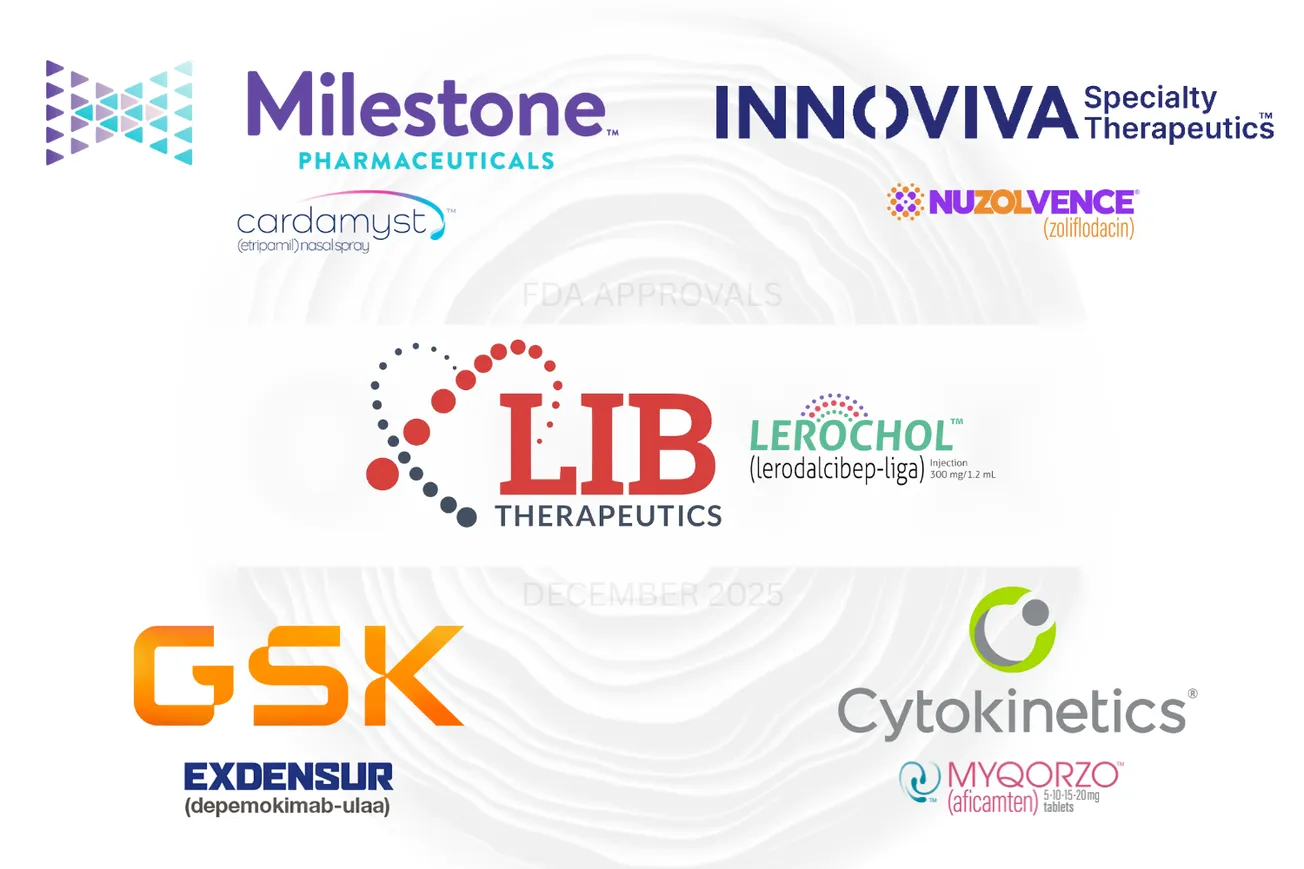
The FDA closed December with five novel approvals spanning cardiology, infectious disease, respiratory medicine, and lipid management, with a notable concentration in cardiovascular conditions that sit between chronic therapy and acute intervention.
The month saw first-in-class mechanisms blended with differentiated delivery strategies, reflecting a regulatory cycle focused on precision and usability rather than breadth.
Cardamyst: Milestone Pharmaceuticals formalizes at-home PSVT rescue
On December 12, Milestone Pharmaceuticals gained approval for Cardamyst (etripamil) nasal spray for the treatment of paroxysmal supraventricular tachycardia in adults.
Etripamil is a short-acting L-type intranasal calcium channel blocker designed for self-administration at symptom onset, targeting AV nodal conduction to terminate reentrant tachycardias. The mechanism is well understood; the innovation is operational. Cardamyst addresses a gap between vagal maneuvers and emergency department care, enabling out-of-hospital rescue therapy.
Approval was supported by the phase 3 RAPID trial, in which patients self-administered treatment during suspected PSVT episodes. Sixty-four percent of etripamil-treated patients converted to sinus rhythm within thirty minutes versus thirty-one percent on placebo, with a median conversion time of seventeen minutes. Adverse events were primarily local nasal effects alongside predictable cardiovascular precautions.
For cardiology, Cardamyst introduces a new care model: episodic, patient-directed intervention that may reduce reliance on emergency department care without redefining chronic rhythm control.
Nuzolvence: Innoviva delivers a new oral antibiotic class
Also on December 12, Innoviva Specialty Therapeutics secured approval for Nuzolvence (zoliflodacin) for uncomplicated urogenital gonorrhea caused by Neisseria gonorrhoeae.
Zoliflodacin is a first-in-class spiropyrimidinetrione antibiotic that inhibits bacterial type II topoisomerases via a binding site distinct from fluoroquinolones. The clinical value is straightforward: a single-dose oral alternative in a disease area increasingly constrained by resistance and dominated by injectable ceftriaxone.
Approval relied on a global phase 3 non-inferiority study demonstrating comparable microbiological cure rates to ceftriaxone-based therapy at urogenital sites, with cure rates exceeding ninety percent. Safety findings included reproductive-toxicity warnings that shape use but do not diminish public health relevance.
The approval was developed through a partnership between Innoviva and the Global Antibiotic Research and Development Partnership, with GARDP holding commercialization rights across most low- and middle-income countries.
Nuzolvence represents meaningful progress in anti-infectives, delivering a new oral mechanism for routine STI care.
Lerochol: LIB Therapeutics extends PCSK9 inhibitor convenience
On December 12, LIB Therapeutics gained approval for Lerochol (lerodalcibep-liga) to reduce LDL cholesterol in adults with hypercholesterolemia, including heterozygous familial hypercholesterolemia.
Lerodalcibep is a PCSK9 inhibitor administered once monthly, enhancing LDL receptor recycling and LDL-C clearance. Mechanistically orthodox, its differentiation rests on dosing interval and formulation stability, aimed at improving adherence relative to existing injectables that require more frequent administration and refrigeration.
The approval draws on the LIBerate phase 3 program, which enrolled more than 2,900 patients and showed substantial LDL-C reductions across high-risk populations. In the pivotal trial in heterozygous familial hypercholesterolemia, lerodalcibep reduced LDL cholesterol by approximately sixty percent versus placebo, with nearly seventy percent of patients achieving guideline targets. No treatment-related serious adverse events were reported in long-term extension studies.
Lerochol intensifies competition in a mature lipid market where persistence and convenience increasingly determine real-world impact. LIB Therapeutics expects commercial availability in spring 2026, pending final launch execution and payer readiness.
Exdensur: GSK stretches IL-5 biology across six months
On December 16, GSK secured approval for Exdensur (depemokimab-ulaa) as add-on maintenance therapy for severe eosinophilic asthma in patients aged twelve years and older.
Depemokimab is an IL-5 blocking monoclonal antibody engineered for twice-yearly dosing, extending beyond the monthly or every-eight-week cadence typical of the class. The mechanism is familiar; the strategic bet is that ultra-long durability can shift adherence and specialist prescribing behavior.
Approval was based on the SWIFT-1 and SWIFT-2 phase 3 trials, which demonstrated sustained reductions in exacerbations versus placebo. Depemokimab reduced annualized exacerbation rates by fifty-eight percent and forty-eight percent in the respective trials, with pooled analyses showing substantial reductions in exacerbations requiring hospitalization or emergency department visits. Safety aligned with existing IL-5 agents.
Exdensur positions GSK to compete on friction reduction in biologic asthma management rather than pathway novelty, entering a market that includes Dupixent, Nucala, and Xolair.
Myqorzo: Cytokinetics deepens the myosin inhibitor franchise
Closing the month on December 19, Cytokinetics gained approval for Myqorzo (aficamten) for adults with symptomatic obstructive hypertrophic cardiomyopathy, the company's first commercial product.
Aficamten is a cardiac myosin inhibitor that reduces hypercontractility and left ventricular outflow tract obstruction. It enters a class defined by clear efficacy but constrained by safety management, with differentiation focused on pharmacokinetics and dosing flexibility.
Approval was supported by the SEQUOIA-HCM and MAPLE-HCM trials, showing improvements in peak oxygen uptake and functional class versus placebo, with the MAPLE trial demonstrating favorable exercise capacity outcomes compared with metoprolol in less symptomatic patients. Like its predecessor mavacamten, Myqorzo carries a boxed warning for heart failure and is distributed under a REMS requiring echocardiographic monitoring.
Myqorzo reinforces myosin inhibition as a durable therapeutic category while sharpening competition around dosing flexibility and clinical workflow. Cytokinetics plans a US launch in late January 2026.
The Strategic Brief
Myqorzo is the most strategically consequential approval, extending a high-value cardiology class and establishing Cytokinetics as a commercial-stage player in HCM management.
Cardamyst and Nuzolvence are operationally disruptive launches; one redefining acute arrhythmia care pathways, the other delivering progress in oral antibiotic innovation for resistant infections.
Exdensur and Lerochol are tactical but important, competing on dosing cadence and adherence rather than biology, in markets where convenience increasingly determines share.
Sources
Cardamyst
U.S. FDA approval announcement – Cardamyst (etripamil) – 12/12/2025
Milestone Pharmaceuticals press release – Cardamyst (etripamil) – 12/12/2025
Nuzolvence
U.S. FDA approval announcement – Nuzolvence (zoliflodacin) – 12/12/2025
Innoviva Specialty Therapeutics press release – Nuzolvence (zoliflodacin) – 12/12/2025
Lerochol
U.S. FDA approval announcement – Lerochol (lerodalcibep-liga)
LIB Therapeutics press release – Lerochol (lerodalcibep-liga) – 12/15/2025
Exdensur
GSK press release – Exdensur (depemokimab-ulaa) – 12/16/2025
Myqorzo
U.S. FDA approval announcement – Myqorzo (aficamten)
Cytokinetics press release – Myqorzo (aficamten) – 12/19/2025





Comments