
Table of Contents
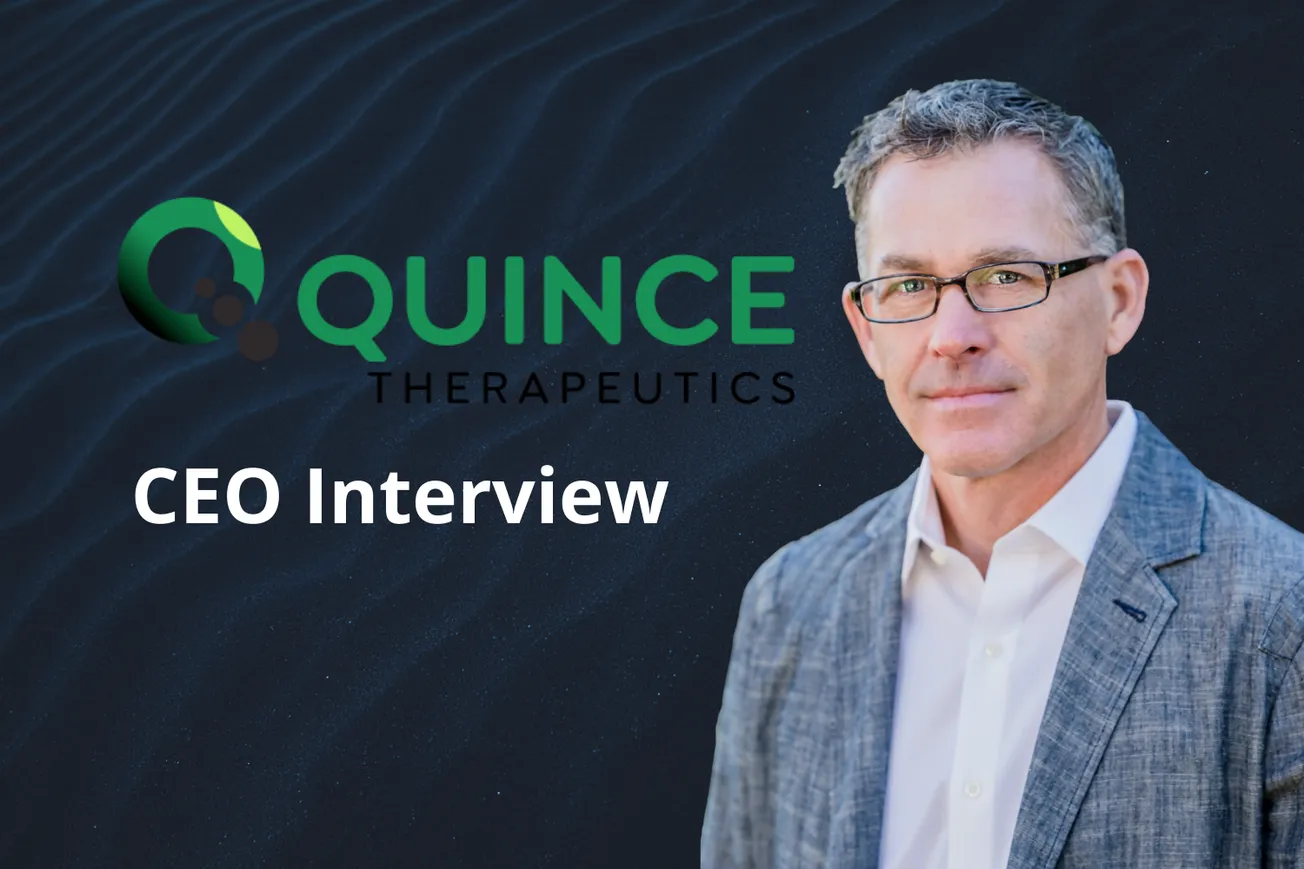
Could you start by giving our readers a bit of background about yourself and your career journey, and what led you to become CEO of Quince Therapeutics?
I went to medical school at UCLA, and I did my residency at Stanford. I was going to be an adult hematologist - a bone marrow transplant doctor. That was the plan. But after internal medicine residency, and seeing where medicine was headed, I decided that I didn’t want to do that anymore.
So, I started a medical device company, and that went pretty well. My second, and third, companies were drug companies, which ended up being very successful. They were sold to J&J and Forest Labs. I ran the third one, inside Forest, for a number of years. We got a couple drugs approved, and then, I went on to do a bunch of small companies. Most were private, but some went public. Usually, I served as CEO, but, sometimes, I was chief medical officer.
Now, at Quince, I’m doing both roles, as I’m the CEO and the chief medical officer.
Could you give an overview of Quince? What are you working on, and how are you trying to benefit patients?
A few years ago, we reverse merged into a failed public company called Cortexyme. They were working in Alzheimer’s, and we basically inherited a public shell, with about $120 million in the bank, but no viable products. Our product was still preclinical.
We had to go shopping for something to forward integrate. Ultimately, we found it in a company called EryDel S.p.A., an Italian company that had been around for 20 years, working on the tech that has now become our platform.
We acquired them two years ago. It’s a drug/device combo that processes a small amount of a patient’s blood - 50 mL, literally like a double shot of espresso, so a drug gets encapsulated inside your red blood cells. Then, the blood is infused back into the patient.
Delivering a drug via a patient’s own red blood cells fundamentally changes the pharmacokinetics, pharmacodynamics, and biodistribution of the drug in really beneficial ways.
Our lead drug is encapsulated dexamethasone sodium phosphate, or eDSP for short. Everyone knows it as a potent steroid. The whole point of putting it inside your red blood cells is so it can be given chronically with no toxicity. Steroids are fantastic drugs, but you just can’t give them for more than a week or two without trouble. This lets us give steroids chronically, for months or years, without those toxicities.
Could you delve a bit deeper into the science behind that? By coupling it with the red blood cell, how are you bypassing the risks of adrenal insufficiency?
Every steroid has a short half-life, even pegylated or liposomal ones. They’re still short enough that you have to dose frequently, usually daily.
If I showed you the concentration on a time curve over several days, you’d see that peak and trough pattern every single day when steroids are administered conventionally. Even at the lowest effective doses, you exceed plasma concentrations that cause these bad toxicities, like diabetes; osteoporosis; weight gain; Cushingoid features; and adrenal suppression.
So, you’re always exceeding those levels. And if you lower the dose to avoid that, the steroid just stops working. There’s no way around it.
But with our approach with eDSP, when you put it inside the patient’s own red blood cell and give it back, you achieve sufficient Cmax on day one, followed by a long, slow decline over a month. And it gets below key toxicity thresholds really quickly.
For adrenal suppression, that’s the most sensitive. Over a one-month period, you're above that threshold only for about seven to ten days. The question is whether that’s too long? So far, the answer looks like no given the strong safety profile of eDSP we’ve seen to date.
We’ve dosed this about 8,000 times, in roughly 425 people. Three of the kids have been dosed monthly for 13 years; and about 70 kids for about three years. So, we have demonstrated a long history of safety with no toxicities associated with conventional steroid administration with our regimen.
So, the big question is: is it efficacious? And that’s what our upcoming Phase 3 readout is all about. If the dose works, it proves the theory that you can get below those concentrations quickly enough to avoid toxicity and deliver an efficacious dose with eDSP.
When we think about adrenal suppression long-term, how reassured can we be by short-term safety profiles? Some consequences come years later.
If all we had was short-term data, you wouldn’t be reassured. But adrenal suppression happens after a week or two. We’ve had patients dosed monthly for years; as I mentioned, for three years and 13 years. We also have cortisol data and a robust safety database.
With adrenal suppression, you’d see it immediately. By month two, you’d already know. And we haven’t seen it in months two through six in clinical studies; or in year two, or in year three in participants who continue on drug. So, it’s very strong evidence that it’s not happening.
How many patients have you dosed, and how do you scale this therapy?
We’ve dosed more than 425 patients overall, which reflects nearly 8,000 infusions. Of those treated with eDSP, roughly 240 include kids with the rare neurodegenerative disease Ataxia–Telangiectasia, or A-T – all of whom we’ve treated in separate Phase 3 and Phase 2 trials.
Our current Phase 3 study has treated 105, and the trial’s duration was six months. And all but one participant rolled over into the open-label extension study so they can get up to two more years of therapy.
So, by the time we file, those 105 patients will have had somewhere between six months and two years of exposure.
How expensive is this therapy? How does that compare to your capital? How do the economics work?
A-T a very rare disease with small patient numbers affected and a very costly drug development effort to bring a first-to-market therapy forward
We expect this dynamic to result in pricing that will be in line with recent rare disease therapeutics launches. Around 5,000 children in the U.S. have this disease with an approximately equal number in Europe as well.
Concerning the machine’s manufacture and administering the infusion, how does it work? On-site? CDMO? In the hospital?
It’s a tabletop machine, similar to the size of an old desktop computer. It sits at the patient’s bedside, or on a cart, or in the blood bank.
You take a double-shot-of-espresso sized blood draw from the patient, pull it into a syringe and hook it up to the machine, outfitted with bags and tubes. It takes 90 minutes to process the blood while the patient waits.
After 90 minutes, you’ve got the blood with the drug encapsulated in a bag. You hang it as an IV drip and reinfuse it. The whole process is completed in about two hours for what is a once-a-month treatment.
The machine is very inexpensive to manufacture, at a cost to us of about $25,000 each. The supply chain takes about nine months to make additional units. And, we’re already preparing for commercialization in A-T, as well as studies in additional indications, to ensure we have enough machines to cover trials and launch.
From a regulatory perspective, we plan to pursue a 505(b)(2) pathway for review and approval of eDSP by the Food and Drug Administration. We are also in good shape from a CMC standpoint, having already completed validation batches, stability, and all that.
No time delay in administering eDSP to the patient? Where will the treatment occur?
There is some urgency. After processing, the stability isn’t long. You need to infuse within about an hour.
Right now, you can’t process remotely. Someday, we’d like to resuspend cells in plasma to increase half-life and give more flexibility. But, for now, it needs reinfusion within 30 to 60 minutes.
We enter a strategic relationship with Option Care, the nation’s leading network of infusion centers, to administer eDSP to patients – ultimately targeting roll out to about 50 of their sites across the U.S. Patients can literally pull up to a mini mall and get treated. Each site will have a machine. That is expected to cover about 85 percent of patients within a 90-minute drive.
Thinking about the rest of the pipeline, could you talk about asset acquisition and how you design your development process? Which assets interest you?
We first want to completely exhaust opportunities with our current drug, eDSP. But our platform can encapsulate basically anything, including enzymes for enzyme replacement, chemo drugs, or many other things.
We're pursuing dexamethasone for rare diseases, but A-T is only the first indication. We have a list of about twelve rare diseases that we want to go after. Those alone will take me the rest of my life.
We're already encapsulating betamethasone, too. Similar potency and PK to dexamethasone but we would utilize it for non-rare disease programs – including lupus, rheumatoid arthritis, and inflammatory bowel disease like UC and Crohn’s.
I would expect those programs to be partnered because the trials are huge and expensive. But we can get them to the point where they’re ready to go into clinical trials. And, again, because they’re already approved steroids differentially delivered with our proprietary encapsulation technology, we can use the 505(b)(2) pathway.
For enzymes and chemo drugs, we’d do those via partnerships because what I have already described is a massive workload, in addition to being outside of our core focus at the moment
What criteria determine whether you advance, partner, or divest an acquired asset?
It’s a mix. First, you look at your corporate and financial reality. How many people do you have? What’s your bandwidth? How much money do you have? How sure are you that you can get more?
If you can’t ensure financing, you look at other options. The non-rare disease trials can cost hundreds of millions, maybe more. Those are multi-billion-dollar programs for big pharma. It would be hard for a small company like Quince that already has twelve rare disease opportunities lined up.
There’s also a gray zone where you're unsure. Time and circumstance teach you what’s possible.
Then, there are commercial considerations. The drug has to fit the biology of the disease. We’re processing blood and reinfusing it, so for something like mild asthma, where an inhaler works fine, just wouldn’t make sense.
There are medical factors; pharmacology; patient characteristics; commercial market; and pricing. All of that has to line up as well.
What outcomes might you see using dexamethasone versus prednisolone, hydrocortisone, or other steroids?
That’s part of choosing diseases. Ideally, you want an equipotent or equally effective drug, relative to the precedent steroid.
But with Ataxia–Telangiectasia, our lead indication, you wouldn’t just take a conventional steroid. You literally can’t since one of the core features of A-Tis immunodeficiency. And steroids cause immunosuppression and other chronic toxicities. That’s why eDSP could be a potential game changer for A-T patients.
However, for diseases like Duchenne muscular dystrophy where almost all the kids are on chronic steroids already, eDSP could be ideal. It is designed to avoid the common problems Duchenne kids have with taking steroids over a long period, including Cushingoid weight gain; behavioral issues; osteoporosis; diabetes. Lots of problems that eDSP could potentially solve for.
So, why dexamethasone? Why is it superior to other corticosteroids to infuse?
You have options. We’re doing betamethasone, too. Dexamethasone was used by our predecessor company EryDel for many years, in multiple studies, so it was the obvious choice, because of all the preceding data.
It’s potent, and its PK profile makes it a good fit for a bunch of diseases.
What milestones should investors look out for in 2026 from Quince?
The big one is early in the year. In the middle of Q1, we’ll report our Phase 3 data from our NEAT trial in A-T.
We’re a small company doing a single pivotal trial. That readout is the biggest inflection point ahead of Quince. If the data’s great, we’re off to the races and can advance eDSP for review by the FDA and rapidly expand our pipeline into additional indications.
Looking at the wider industry, what’s the temperature in the room right now? Funding’s been turbulent. CEOs at Jefferies mentioned cautious optimism. What have you been hearing?
Biotech cycles are wild. In April 2025, it was like the end of the world, as nobody could raise money. That wasn't long ago; but now, it feels completely different. Lots of capital around and a more positive sentiment overall.
But it could change again. In biotech, I’ve learned that if you have a chance to get money, take it. You’re never certain that it’ll be there, next time, especially if you're a smaller company.
You mentioned earlier that after residency you assessed where medicine was going and decided to start a medical-device company. Could you expand on that - where you thought medicine was going and where it actually went?
We could talk for hours. I was going to be an academic bone marrow transplant physician - super intellectually stimulating and technologically complex. It would’ve been a great career.
But, at Stanford, at the time, there was this idea that drug development was controlled by big pharma and often viewed negatively. Going into industry wasn’t common. I became a sort of black sheep.
I could see academic medicine getting really complicated, with funding drying up; more pressure; less time with patients; lower compensation; and less autonomy. All the things that attracted me to medicine were disappearing.
So, I changed direction. I took some heat for it. But, ten years later, those same people were calling me for jobs.
But academic medicine has wonderful parts, too, which I left behind. There’s no perfect path. I’ve done a lot of interesting things, just in a different environment. And that diversity and depth of experience is what matters the most.
From your experience, what advice would you offer a new biotech executive, especially in rare disease?
I don’t love blanket advice because everyone’s different. But I’d say: find someone who has the experience and knowledge you don’t. Be honest with yourself about what you're good at and what you’re not. Fill the gaps.
I’ve been doing this for 30 years, serving as a CEO ten times, and I still have plenty to learn! Never stop learning. Never pretend you know everything. There’s always someone who’s done things that you haven’t, so lean on them.